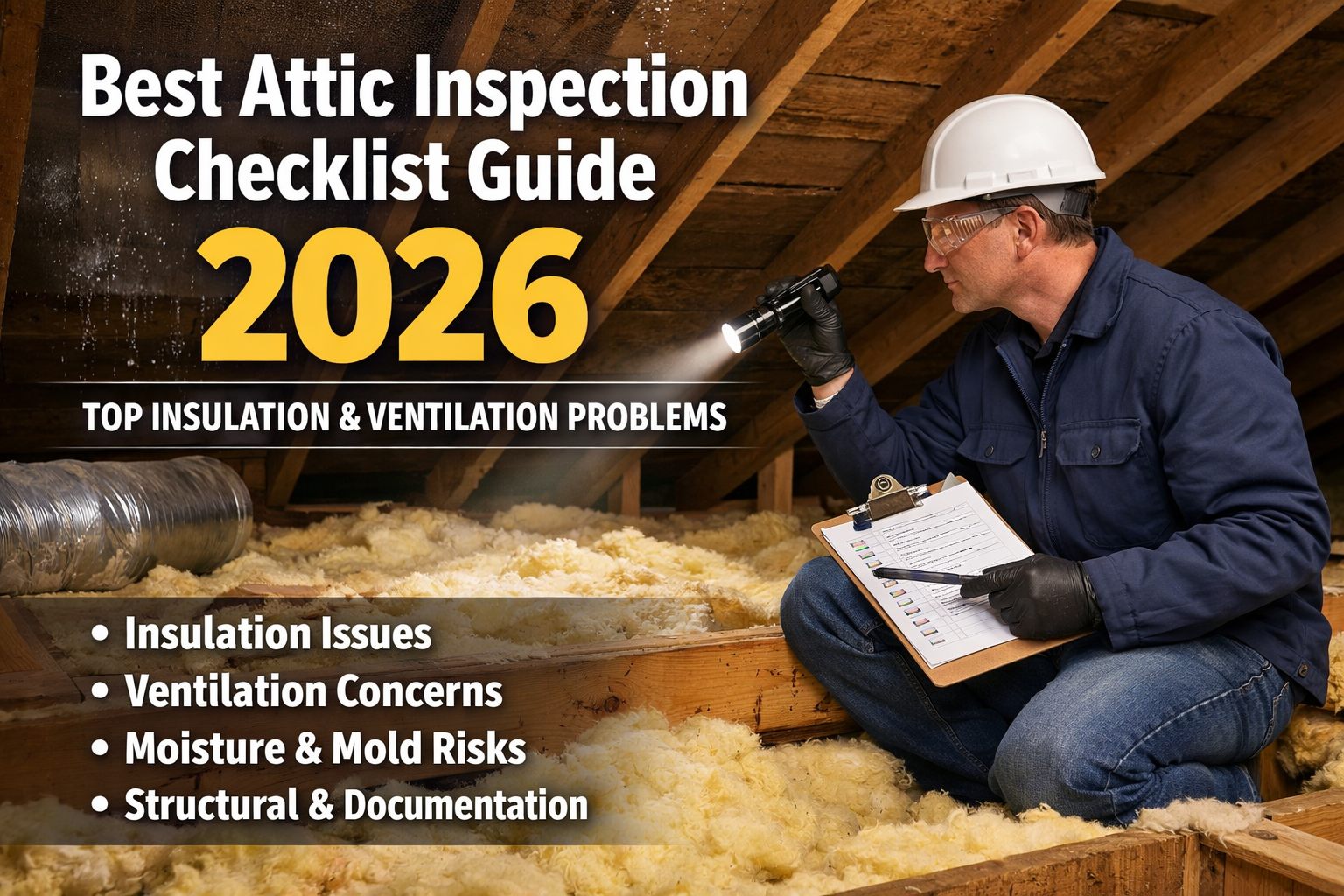

The attic tells stories about a home's health that no other space canmoisture patterns, ventilation effectiveness, insulation performance, and structural integrity are all on display if you know where to look. This checklist covers the most common attic issues with specific guidance on how to identify, document, and report each one.
Before You Enter: Safety & Setup
Attic inspections require preparation. Take these steps before climbing up.
Personal Protection
Dust mask/N95, safety glasses, gloves, long sleeves. Knee pads help for movement.
Lighting
Bright flashlight + headlamp. Wait 30 seconds before turning on lights to spot daylight penetration.
Movement
Walk only on joists or framing. Plywood sheets help distribute weight. Never step on drywall or insulation.
Documentation
Phone/camera ready. Moisture meter if available. Note pad for measurements.
Category 1: Moisture & Water Intrusion
Moisture is the most damaging attic issue. It leads to mold, rot, insulation failure, and structural damage. Always start here.
Water Stains on Decking
High PriorityWhat to Look For
Dark discoloration on the underside of roof sheathing, especially around penetrations (vents, chimneys, skylights), in valleys, and at the eaves.
How to Document
Photo: Include surrounding area for context. Use flash to show stain boundaries clearly.
Report language: "Water staining observed on roof sheathing in [location]. Pattern suggests [active leak/past leak]. Recommend further evaluation by qualified roofer."
Condensation & Frost
High PriorityWhat to Look For
Water droplets or frost on nail tips, sheathing, or framing (winter). Indicates warm moist air from living space reaching cold attic surfacesa ventilation and/or air sealing problem.
How to Document
Photo: Close-up of affected nails/surfaces showing moisture or frost crystals.
Report language: "Condensation/frost observed on [nail tips/sheathing] indicating inadequate ventilation and/or air leakage from conditioned space. Recommend improving attic ventilation and sealing air leaks."
Mold Growth
High PriorityWhat to Look For
Black, green, or white fuzzy growth on sheathing, framing, or insulation. Often concentrated near moisture sources. May have musty odor even when not visible.
How to Document
Photo: Overall extent and close-up of affected area. Include a reference object for scale.
Report language: "Apparent mold-like growth observed on [location]. Approximately [X] sq ft affected. Recommend evaluation by qualified mold remediation specialist and correction of moisture source."
Note: Inspectors identify visual evidence but don't confirm mold species—that requires lab testing.
Category 2: Ventilation
Proper ventilation requires balanced intake (soffits) and exhaust (ridge/gable vents). Imbalance leads to moisture problems, heat buildup, and premature roof aging.
Blocked Soffit Vents
High PriorityWhat to Look For
Insulation pushed against or covering soffit vents at the eaves. Very common—happens during insulation installation or when homeowners add blown-in insulation without baffles.
How to Document
Photo: Show insulation blocking the soffit area. Include a shot showing the eave edge where vents should be clear.
Report language: "Soffit vents blocked by insulation at [location/extent]. This restricts air intake and can lead to moisture problems and heat buildup. Recommend installing ventilation baffles and clearing obstructions."
Inadequate Exhaust Ventilation
Medium PriorityWhat to Look For
Missing, damaged, or undersized ridge vents, gable vents, or roof vents. Signs of heat buildup (blistered shingles visible from attic side, excessive heat during inspection).
How to Document
Photo: Document existing exhaust vents and their condition. Note if they appear undersized for attic volume.
Report language: "Exhaust ventilation appears [inadequate/damaged]. [Specific issue]. Signs of [heat buildup/moisture retention] observed. Recommend evaluation by roofing contractor for ventilation improvements."
Bath Fans Venting Into Attic
High PriorityWhat to Look For
Bathroom exhaust ducts that terminate in the attic space rather than outside. Major moisture source—one of the most common causes of attic mold and condensation problems.
How to Document
Photo: Show the duct termination point clearly. Include any moisture damage or mold growth in the surrounding area.
Report language: "Bathroom exhaust fan duct terminates in attic space rather than exterior. This introduces warm, moist air into the attic and can cause condensation, mold growth, and insulation damage. Recommend extending duct to terminate outside building envelope."
Category 3: Insulation
Insulation problems directly impact energy costs. Blown-in insulation can settle 20-30% over time, and gaps around penetrations are extremely common.
Insufficient Depth/Coverage
Medium PriorityWhat to Look For
Insulation level at or below the top of floor joists (should be above). Visible joists across large areas. Settled blown-in insulation with gaps. Measure depth in multiple locations.
How to Document
Photo: Show insulation level relative to joists. Include a ruler or tape measure for depth.
Report language: "Attic insulation depth measured at approximately [X] inches of [type]. Current R-value estimated at R-[X]. Current standards recommend R-38 to R-60 for this climate zone. Consider adding insulation for improved energy efficiency."
Gaps Around Penetrations
Medium PriorityWhat to Look For
Missing insulation around plumbing stacks, electrical penetrations, HVAC equipment, recessed lights, and attic access hatches. These small gaps significantly impact energy efficiency.
How to Document
Photo: Show gap with surrounding insulation for contrast. Identify what penetration it's around.
Report language: "Insulation gaps observed around [penetration type] at [location]. These gaps allow conditioned air to escape and can significantly reduce insulation effectiveness. Recommend air sealing and insulation repair."
Damaged or Contaminated Insulation
Medium PriorityWhat to Look For
Compressed, wet, discolored, or pest-damaged insulation. Water-damaged insulation loses effectiveness and may harbor mold. Pest contamination requires removal for health reasons.
How to Document
Photo: Show damaged area and extent. Include healthy insulation nearby for comparison if possible.
Report language: "Insulation in [location] appears [damaged/compressed/water-stained/contaminated by pests]. Approximately [X] sq ft affected. Damaged insulation has reduced R-value and [may harbor mold/poses health concerns]. Recommend removal and replacement."
Category 4: Structure & Framing
Structural issues in the attic can indicate foundation problems, roof stress, or improper modifications. Always document carefully.
Rafter/Truss Damage
High PriorityWhat to Look For
Cracked, split, sagging, or bowing rafters/trusses. Cut or notched truss members (improper modifications). Signs of overloading from storage. Water damage or rot in framing.
How to Document
Photo: Capture the defect clearly with surrounding framing for context. Multiple angles help.
Report language: "Structural concern observed: [specific issue] at [location]. [Describe extent/severity]. Recommend evaluation by licensed structural engineer before any repairs."
Sheathing Condition
Medium PriorityWhat to Look For
Delaminating plywood/OSB, soft spots, sagging between rafters, rot, or daylight visible through the roof. Indicates water damage or failed roof covering.
How to Document
Photo: Show affected area. Note if damage is localized or widespread.
Report language: "Roof sheathing shows [delamination/soft spots/sagging/daylight penetration] at [location]. This indicates [water damage/roof covering failure] and compromised structural integrity. Recommend repair by qualified roofing contractor."
Category 5: Electrical & Fire Safety
The attic often contains junction boxes, wiring, and HVAC equipment. Safety hazards here pose serious risks.
Wiring Issues
High PriorityWhat to Look For
Exposed splices (not in junction boxes), damaged wire insulation, wiring buried in insulation without proper rating, evidence of DIY electrical work, knob-and-tube wiring.
How to Document
Photo: Show the hazard clearly. Do not touch or disturb electrical components.
Report language: "Electrical safety concern: [specific issue] observed at [location]. [Open splices/damaged insulation/improper installation] present fire and shock hazards. Recommend evaluation and repair by licensed electrician."
HVAC & Flue Clearances
High PriorityWhat to Look For
Insulation or combustibles too close to flues, chimneys, or recessed lights. Disconnected HVAC ducts. Leaking ductwork. Furnace or water heater exhaust not properly vented.
How to Document
Photo: Show clearance (or lack thereof) between heat source and combustibles. Include measurement if possible.
Report language: "Fire hazard: [Insulation/combustibles] in contact with [flue/chimney/recessed light] at [location]. Required clearance is [X] inches. Recommend immediate removal of combustible materials and installation of proper barriers."
Pest Evidence
Medium PriorityWhat to Look For
Droppings, nesting materials, chewed wood/wires/insulation, entry points at eaves or gable vents, dead animals, urine stains on insulation.
How to Document
Photo: Document evidence and likely entry points. Note extent of contamination.
Report language: "Evidence of [rodent/wildlife] activity observed: [droppings/nesting/damage] at [location]. Entry points noted at [location]. Recommend pest control evaluation, removal of contaminated materials, and sealing of entry points."
Quick Reference Checklist
Use this condensed checklist during every attic inspection.
Moisture & Water
Ventilation
Insulation
Structure
Safety
Report Writing Tips
Be Specific About Location
Use compass directions, distances from access point, or reference landmarks: "Northeast corner, approximately 8 feet from attic hatch, above master bathroom."
Quantify When Possible
Measurements make reports more useful: "Insulation depth averages 6 inches" is better than "insulation appears thin."
Describe, Don't Diagnose
Report what you see, not what you think caused it: "Black discoloration consistent with mold growth" rather than "mold from roof leak."
Use Consistent Terminology
Pick terms and stick with them: "sheathing" vs "decking," "rafters" vs "trusses." Clients get confused when you switch.
Frequently Asked Questions
How long should an attic inspection take?
For a typical residential attic (1,500-2,500 sq ft home), plan for 15-20 minutes. Larger homes, multiple attic spaces, or homes with significant issues will take longer. Don't rush—attic issues are commonly missed.
What if I can't access the entire attic?
Document what you can see and note inaccessible areas in your report. Common limitations include insufficient clearance, unsafe flooring, or HVAC equipment blocking access. Always explain why areas couldn't be inspected.
Should I identify mold species?
No. Inspectors identify "apparent mold-like growth" or "suspected microbial growth" and recommend evaluation by a specialist. Species identification requires lab testing by a qualified professional.
What's the minimum insulation depth I should expect?
Current standards recommend R-38 to R-60 depending on climate zone. For blown-in fiberglass, that's roughly 10-16 inches. Older homes often have much less. Report actual measurements and let clients know current recommendations.
Attic Checklists That Guide Your Workflow
HomeInspecto includes all 5 attic categories with photo prompts and pre-written report comments.
- Category-based inspection flow
- Pre-written defect comments
- Photo organization by issue type
- Works offline in the field