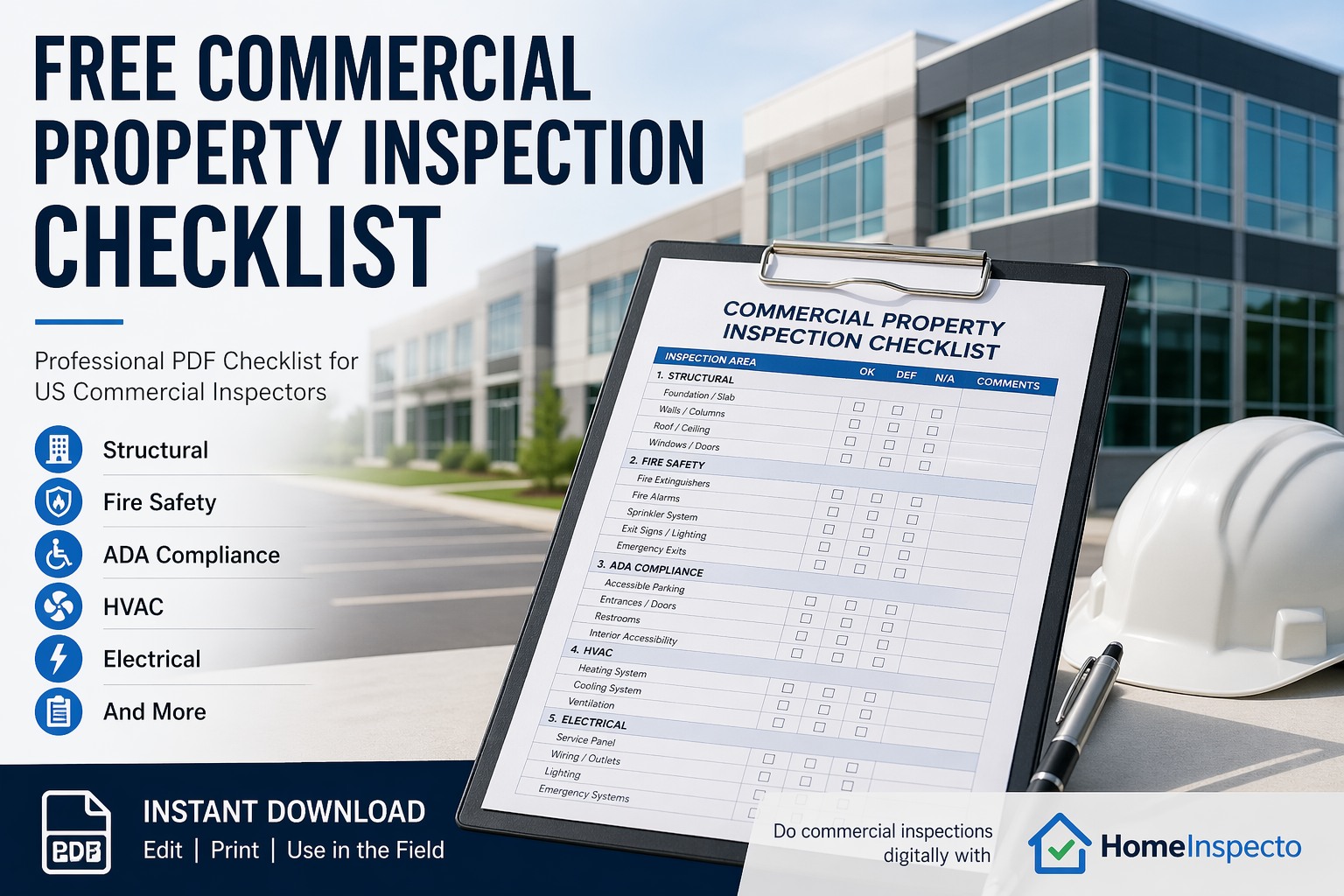
Commercial property inspections are fundamentally different from residential — they involve overlapping regulatory frameworks including IBC structural codes, NFPA fire safety standards, ASHRAE mechanical requirements, ADA accessibility mandates, and local municipal ordinances that vary by jurisdiction. A single missed finding can cascade into six-figure compliance penalties, and electrical problems alone appear in 60–70% of commercial inspections, making them the single most frequent deficiency. Whether you're inspecting an office building, retail center, warehouse, restaurant, or mixed-use property, this 180+ item checklist covers every system a commercial inspector must evaluate — from structural integrity and roof systems to fire/life safety, ADA compliance, environmental hazards, and building envelope. Review the complete checklist below, then book a demo to see how HomeInspecto turns this into a guided digital workflow with photo documentation, deficiency tracking, and branded PDF delivery.

Commercial Inspection — 2026 Edition

Free Commercial Property Inspection Checklist

180+ items across 12 critical systems. ComSOP & ASTM E2018 aligned. Covers office, retail, warehouse, restaurant & mixed-use properties.
180+Inspection Items

12Critical Systems

ComSOPStandards Aligned

ADACompliance Included

Why Commercial Inspections Require a Different Checklist

Commercial buildings operate under regulatory frameworks that residential properties never touch — IBC structural codes, NFPA fire/life safety standards, ASHRAE mechanical requirements, ADA accessibility mandates, and environmental regulations. Using a residential checklist for commercial properties creates dangerous compliance gaps.

$4.7B
Annual compliance penalties from missed commercial inspections across US facilities
60–70%
Of commercial inspections find electrical problems — the single most common deficiency
$75K
First-time ADA violation fine for a single complaint — plus mandatory retrofit costs
$25K+
Fines for missing fire safety equipment, blocked exits, or faulty sprinkler systems

Complete Commercial Property Inspection Checklist

This checklist follows the ComSOP (International Standards of Practice for Inspecting Commercial Properties) framework and aligns with ASTM E2018 property condition assessment standards. Use it for due diligence inspections, annual compliance reviews, or pre-lease evaluations. Book a demo to see how HomeInspecto turns every item into a guided digital workflow.

01

Structural Systems & Foundation

20 checkpoint items
Foundation type — slab, pier, basement, crawlspace
Foundation walls — cracks (hairline vs. structural), spalling, bowing
Foundation — horizontal cracks, stair-step cracks in masonry
Slab condition — settlement, heaving, expansion joints
Load-bearing walls — bowing, leaning, bulging
Columns & beams — corrosion, deflection, fire rating
Steel framing — rust, corrosion, connection integrity
Concrete — spalling, exposed rebar, efflorescence
Floor systems — sagging, deflection, load capacity signage
Roof structure — framing, decking, load capacity
Expansion joints — condition, sealant, movement
Retaining walls — condition, drainage, lean
Loading docks — structural condition, bumpers, levelers
Stairways — structural support, treads, risers
Mezzanines — structural integrity, load ratings posted
Parking structure — concrete condition, rebar exposure
Evidence of water intrusion at structural elements
Evidence of prior structural repairs or modifications
Seismic bracing & connections (where applicable)
Overall structural integrity assessment & documentation
02

Roofing Systems

18 checkpoint items
Roof type — TPO, EPDM, modified bitumen, metal, BUR
Membrane condition — blistering, punctures, seam integrity
Ponding water — standing water 48+ hours after rain
Flashing — penetrations, HVAC curbs, skylights, parapet caps
Roof drains & scuppers — blockage, debris, drainage function
Expansion joints — sealant condition, movement capacity
Parapet walls — capping, coping stones, condition
Roof-mounted equipment — HVAC units, exhaust fans, supports
Roof access — hatches, ladders, safety rails, OSHA compliance
Skylights — condition, seals, flashing, safety screens
Interior leak evidence — stains, mold, damaged ceiling tiles
Insulation — type, R-value, moisture damage (where visible)
Gutters & downspouts — commercial drainage system condition
Roof warranty — status, transferability, remaining term
Estimated roof age & remaining service life
Number of roof layers / re-cover history
Roof maintenance records — last inspection, repairs
Overall roofing system assessment
03

Building Envelope & Exterior

16 checkpoint items
Exterior cladding — type, condition, cracks, moisture staining
Masonry — mortar joints, cracking, efflorescence, spalling
EIFS / stucco — cracks, delamination, moisture probing
Windows — commercial glazing, seals, operation, condensation
Storefronts & curtain walls — seals, gaskets, drainage
Exterior doors — commercial hardware, closers, thresholds
Sealants & caulking — joints, penetrations, age, condition
Loading areas — overhead doors, dock seals, drainage
Signage — mounting, condition, electrical connections
Canopies & awnings — structural attachment, condition
Exterior lighting — parking, pathway, security, operation
Grading & drainage — away from building, site drainage
Landscaping — irrigation, tree clearance from structure
Dumpster / trash enclosures — condition, screening
Fencing & security — gates, locks, condition
Overall building envelope assessment
04

HVAC & Mechanical Systems

18 checkpoint items
Equipment inventory — RTUs, split systems, boilers, chillers
Equipment age, manufacturer, model, capacity for each unit
Operation verification — heating & cooling modes
Air handlers — condition, coils, blowers, filters
Ductwork — visible condition, insulation, connections
Zoning & controls — BMS/BAS, thermostats, zone dampers
Refrigerant lines — insulation, condition, type (R-22 phase-out)
Condensate management — drains, pans, pumps
Boiler systems — operation, combustion, pressure, safety valves
Cooling towers — condition, water treatment, drift eliminators
Exhaust systems — kitchen hoods, restroom exhaust, make-up air
Ventilation — outdoor air intake, ASHRAE 62.1 compliance
Energy efficiency — SEER/EER ratings, ASHRAE 90.1 compliance
Maintenance records — service history, filter change schedule
Estimated remaining useful life per unit
Refrigerant management — leak history, R-22 to R-410A plan
Indoor air quality — odors, humidity, CO2 levels
Overall HVAC system assessment & CapEx forecast
05

Electrical Systems

18 checkpoint items
Service entrance — utility feed, voltage, amperage, metering
Main switchgear — manufacturer, age, condition, capacity
Distribution panels — labeling, condition, available capacity
Transformers — pad-mount or interior, condition, oil leaks
Bus ducts & feeders — condition, routing, code compliance
Grounding & bonding — electrode system, equipment grounding
Branch circuits — wiring method, condition, load capacity
GFCI protection — restrooms, kitchens, exterior, wet areas
Emergency power — generator, ATS, fuel supply, load bank test
UPS systems — battery condition, runtime, age
Lighting systems — type (LED, fluorescent), controls, energy code
Emergency lighting — battery backup, exit signs, egress lighting
Exterior lighting — parking, security, pathway, photocells
Panel clearance — NEC 36-inch rule, working space
Arc flash labels — present, current study on file
Electrical room conditions — ventilation, access, storage
Three-phase power — balance, voltage readings
Overall electrical system assessment & capacity adequacy
06

Plumbing Systems

14 checkpoint items
Water service — meter, main shut-off, pipe material, size
Supply piping — material (copper, PEX, galvanized), condition
Drain/waste/vent — material, condition, cleanout access
Commercial water heaters — type, capacity, age, operation
Backflow prevention — RPZ or DC assemblies, annual test tags
Grease traps / interceptors — condition, pumping schedule
Restroom fixtures — operation, condition, ADA compliance
Floor drains — function, trap primers, covers
Sewer connection — public vs. private, condition, camera scope
Sump pumps & ejector pumps — operation, alarms
Gas piping — material, routing, shut-offs, leak detection
Domestic hot water — delivery, temperature, mixing valves
Water pressure & flow — adequate for building occupancy
Overall plumbing system assessment
This checklist covers 12 major systems with 180+ checkpoints. HomeInspecto turns every item into a guided digital workflow with photo documentation, deficiency severity ratings, and branded PDF reports — built for commercial inspection professionals.
07

Fire & Life Safety Systems

20 checkpoint items
Fire alarm panel — type, age, monitoring service, condition
Smoke & heat detectors — locations, test dates, coverage
Pull stations — locations, operation, signage
Notification appliances — horns, strobes, voice evacuation
Fire sprinkler system — type (wet, dry, pre-action), coverage
Sprinkler heads — condition, clearance, obstruction, paint
Sprinkler risers — gauges, valves, tamper switches, flow switches
Fire pump — operation, test records, capacity
Standpipe system — connections, hose valves, signage
Fire extinguishers — locations, types, inspection tags, mounting
Kitchen suppression — hood system, Ansul/wet chemical
Fire doors — rating labels, closers, latching, gap clearance
Fire-rated walls & assemblies — penetrations sealed, integrity
Emergency egress — exit routes clear, unobstructed, marked
Exit signs — illuminated, battery backup, proper placement
Emergency lighting — coverage, battery test, duration
Fire department connection (FDC) — accessible, signage, caps
Evacuation plans — posted, current, legible
Fire inspection records — last fire marshal visit, violations
Overall fire & life safety assessment
08

ADA Accessibility & Compliance

18 checkpoint items
Accessible parking — count, signage, van-accessible, slope
Accessible route — parking to entrance, slope max 1:12
Curb ramps — presence, slope, detectable warnings
Entrance — accessible, 32" min clear width, threshold height
Door hardware — lever handles, opening force (max 5 lbs interior)
Interior routes — 36" min width, 60" turning radius at corridors
Elevator — present, cab size, controls height, Braille buttons
Restrooms — accessible stall, 60" turning diameter, grab bars
Restroom fixtures — lavatory height, knee clearance, lever faucets
Restroom accessories — mirror height (40" max), dispensers reach range
Signage — tactile/Braille room signs, mounting height & location
Service counters — lowered section (max 36" height)
Drinking fountains — accessible height, knee clearance
Ramps — slope (max 1:12), handrails, edge protection, landings
Stairs — handrails both sides, extensions, tactile warnings
Communication — visual alarms in restrooms & common areas
Barrier removal plan — documented, prioritized, dated
Overall ADA compliance assessment
09

Interior Spaces & Finishes

12 checkpoint items
Walls & partitions — condition, damage, tenant improvements
Ceilings — drop ceiling tiles, grid condition, stains, sag
Flooring — carpet, tile, VCT, concrete — condition, trip hazards
Interior doors — operation, hardware, closers, ADA width
Restrooms — fixtures, ventilation, cleanliness, supplies
Break rooms / kitchens — appliances, plumbing, ventilation
Common areas — lobbies, corridors, stairwells — condition
Tenant spaces — demised areas, condition, improvements
Storage areas — condition, shelving, fire rating (if required)
Janitorial / mechanical closets — ventilation, storage, condition
Evidence of moisture, mold, or pest activity
Overall interior condition assessment
10

Environmental & Hazardous Materials

12 checkpoint items
Asbestos — ACM survey, management plan (pre-1980 buildings)
Lead-based paint — testing results (pre-1978 buildings)
Mold — visible growth, moisture sources, remediation history
Radon — testing results, mitigation system (if present)
PCBs — transformers, ballasts, caulking (pre-1979 buildings)
Underground storage tanks (USTs) — records, decommissioning
Above-ground storage tanks (ASTs) — fuel, chemical, condition
Phase I ESA — environmental site assessment status
Stormwater management — BMP condition, compliance
Hazardous waste — storage, labeling, disposal records
Indoor air quality — testing history, ventilation adequacy
Overall environmental assessment & recommendations
11

Site, Parking & Grounds

14 checkpoint items
Parking lot — pavement condition, striping, curbs, potholes
ADA parking — count per total spaces, signage, access aisle
Site drainage — grading, storm drains, retention/detention
Sidewalks — condition, trip hazards, ADA route compliance
Site lighting — parking, pathways, building perimeter
Landscaping — condition, irrigation, clearance from building
Fencing & perimeter security — condition, gates, access control
Signage — monument, directional, tenant, regulatory
Loading zones — access, condition, truck turning radius
Fire lanes — marked, unobstructed, signage
Utilities — locations, access, meters, shut-off identification
Trash & recycling — enclosures, capacity, collection access
Adjacent properties — encroachments, easements, conditions
Overall site condition assessment
12

Vertical Transportation & Conveyance

10 checkpoint items
Elevators — type (hydraulic, traction), age, manufacturer
Elevator operation — leveling, door function, ride quality
Elevator cab — condition, ADA controls, emergency phone
Elevator inspection certificate — current, posted in cab
Elevator machine room — condition, temperature, access
Escalators / moving walkways — operation, safety features
Freight elevators — capacity posting, operation, condition
Wheelchair lifts — operation, ADA compliance, inspection cert
Maintenance records — service contract, modernization history
Overall vertical transportation assessment

180+ Commercial Checkpoints. One Digital Platform.

Book a demo and we'll walk you through how HomeInspecto handles commercial inspections — with guided workflows, photo documentation, deficiency severity ratings, and branded PDF reports.

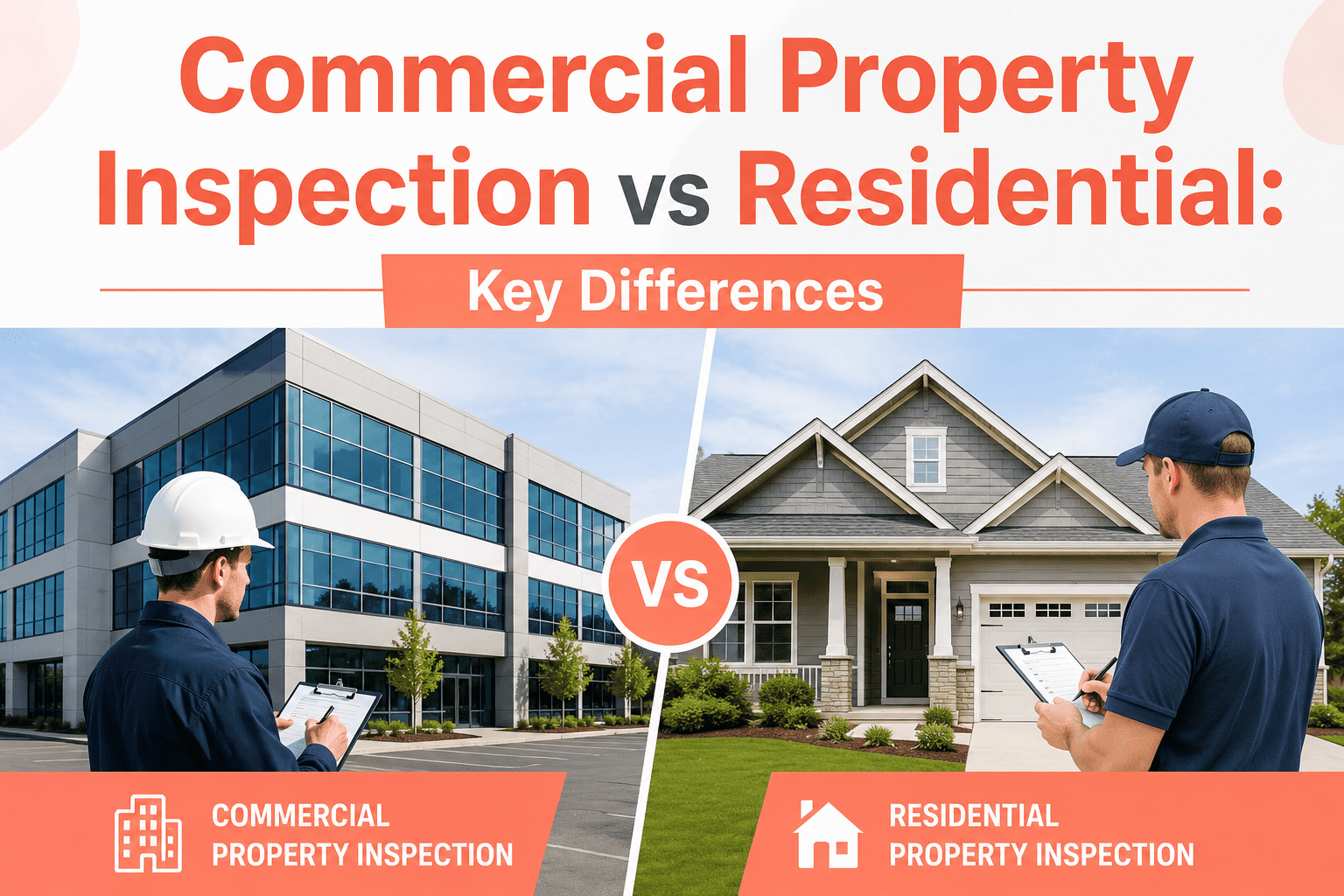
Commercial vs. Residential Inspections: Key Differences

Commercial property inspections are a fundamentally different discipline from residential. The scope is broader, the regulatory requirements are stricter, and the financial stakes are significantly higher. Here's how they compare.

Factor
Residential
Commercial
Standard
ASHI / InterNACHI SOP
ComSOP / ASTM E2018
ADA Compliance
Not required
Required for public-facing
Fire Systems
Smoke detectors, basic
Sprinklers, alarms, suppression, egress
Electrical
Single-phase, 200A typical
Three-phase, switchgear, generators
HVAC
Furnace + AC, simple
RTUs, chillers, boilers, BMS, zoning
Environmental
Radon, mold optional
Phase I ESA, asbestos, PCBs, USTs
Elevators
Rarely applicable
Required inspection & certification
Typical Duration
2–4 hours
4–8+ hours (varies by size)
Report Scope
Deficiency list
CapEx forecast + deficiency matrix

Property Types This Checklist Covers

Commercial inspections vary by property type, but the core systems remain consistent. This checklist is designed to cover the full range of commercial properties — add or remove sections based on the specific property you're evaluating.

Office Buildings

HVAC zoning, elevator systems, ADA, tenant improvements, common areas

Retail / Strip Mall

Storefronts, ADA access, fire suppression, signage, parking, tenant demising

Warehouse / Industrial

Clear height, loading docks, fire sprinklers, floor load capacity, overhead doors

Restaurant / Food Service

Kitchen suppression, grease traps, exhaust hoods, health code, walk-in coolers

Mixed-Use

Multi-system complexity, separate metering, fire separation, varied ADA needs

Medical / Healthcare

Specialized HVAC, infection control, generator backup, ADA, medical gas

One platform for every commercial property type. HomeInspecto supports office, retail, warehouse, restaurant, mixed-use, and medical inspections — with customizable templates, photo documentation, and branded PDF delivery.

Frequently Asked Questions

What standards govern commercial property inspections?
The ComSOP (International Standards of Practice for Inspecting Commercial Properties) is the industry-accepted standard used by commercial inspectors. For property condition assessments during real estate transactions, ASTM E2018 is the benchmark. Both standards define which systems must be evaluated, how findings should be documented, and what falls within or outside the scope of a commercial inspection. Our checklist covers the union of both frameworks.
How is a commercial inspection different from residential?
Commercial inspections cover systems that residential properties never have — three-phase electrical, fire sprinkler and suppression systems, ADA compliance, elevator certification, environmental hazards (asbestos, PCBs, USTs), building management systems, and commercial HVAC equipment like RTUs, chillers, and boilers. The regulatory requirements are stricter, the report typically includes a capital expenditure forecast, and inspections take 4–8+ hours depending on property size.
Is ADA compliance part of a commercial inspection?
Yes. ADA accessibility is a critical component of any commercial property inspection for public-facing buildings. Inspectors evaluate accessible parking, entrance routes, door widths and hardware, restroom compliance, elevator accessibility, signage, and service counter heights. Non-compliance can trigger federal lawsuits, DOJ fines starting at $75,000 for a first-time violation, and mandatory retrofits. Book a demo to see how HomeInspecto documents ADA findings with measurement photos and compliance ratings.
How often should commercial buildings be inspected?
Best practice is annual full inspections at minimum, with quarterly walkthroughs for safety-critical systems. Fire safety equipment, HVAC, and electrical panels should receive at least annual attention. High-rise buildings may require structural and electrical assessments every five years. Some states have increased requirements — Florida, for example, mandates milestone inspections for buildings reaching 25–30 years of age.
What does a commercial inspection cost?
Commercial inspection costs vary widely based on property size, type, and complexity — typically ranging from $1,000 to $5,000+ for standard commercial buildings, with larger or more complex properties costing significantly more. A full ASTM E2018 property condition assessment with capital expenditure forecasting can run $3,000–$10,000+. The investment is small relative to the acquisition cost and the potential liabilities uncovered.
Can HomeInspecto handle commercial inspections?
Yes. HomeInspecto supports custom commercial templates covering all 12 systems in this checklist — including fire/life safety, ADA compliance, environmental, and vertical transportation sections that residential software doesn't include. Photo documentation, deficiency severity ratings, and branded PDF reports are built for the level of detail commercial inspections require. Book a demo to see the commercial workflow, or start a free trial.

Commercial-Grade Inspections. Digital Workflow. Professional Reports.

Book a demo to see how HomeInspecto handles commercial property inspections — with guided workflows for all 12 systems, photo documentation, deficiency tracking, and branded PDF delivery. Or start free.