
Foundation cracks are one of the most misreported findings in home inspections. Overcall every hairline crack as "structural," and you lose credibility with agents and alarm clients unnecessarily. Undercall a serious crack, and you face expensive liability claims. This guide gives you the exact language to report foundation cracks clearly, professionally, and accurately.
Quick Reference: Crack Severity + Report Language
Match what you see to the right report language:
What You See
- Hairline cracks (<1/16")
- Vertical cracks, uniform width
- No displacement or offset
- Edges appear old/weathered
How to Report It
What You See
- Cracks 1/8" to 1/4" wide
- Diagonal cracks (settling)
- Stair-step in block walls
- Signs of water seepage
How to Report It
What You See
- Cracks wider than 1/4"
- Horizontal cracks (any width)
- Displacement or wall bowing
- Multiple interior symptoms
How to Report It
Crack Pattern Cheat Sheet
Different patterns indicate different causes—here's how to describe each:
Vertical
Low ConcernCause: Normal settling, concrete shrinkage
Write: "Vertical crack consistent with typical concrete curing/settling..."
Horizontal
High ConcernCause: Soil pressure, hydrostatic pressure
Write: "Horizontal crack indicating possible lateral soil pressure. Engineer evaluation recommended..."
Diagonal
Medium ConcernCause: Differential settlement
Write: "Diagonal crack suggesting differential settlement. Monitor for progression..."
Stair-Step
High ConcernCause: Settlement in block/brick walls
Write: "Stair-step cracking following mortar joints indicating foundation movement..."
Real Scenarios: How to Write Each Finding
Here are common situations you'll encounter and exactly how to report them:
New Construction Shrinkage Cracks
"Several hairline cracks (less than 1/16" wide) observed in the foundation walls. These cracks are typical of concrete shrinkage that occurs during the curing process in newer construction. No signs of water intrusion or structural concern were observed at the time of inspection. Recommend sealing if water seepage develops and monitoring for any changes in width or length."
Old Crack, Previously Repaired
"A previously repaired foundation crack was observed at the [location]. The repair appears to be holding with no visible signs of new cracking or movement adjacent to the repair. This suggests the original crack has stabilized. Recommend continued monitoring as part of routine maintenance."
Horizontal Crack with Wall Bowing
"A horizontal crack was observed approximately [X] feet from the floor on the [location] basement wall. The wall shows visible inward deflection of approximately [X] inches at the crack location. Horizontal cracking with wall displacement typically indicates lateral soil pressure exceeding the wall's design capacity. This is a significant structural concern. Recommend evaluation by a licensed structural engineer prior to closing to assess the extent of damage and determine appropriate repair methods."
Crack with Active Water Intrusion
"Foundation crack observed at [location] with evidence of water intrusion including mineral deposits (efflorescence) and moisture staining. While the crack itself appears to be a settlement crack, water entry through foundation cracks can lead to mold growth and further deterioration. Recommend having the crack professionally sealed with appropriate waterproofing material and evaluating exterior drainage to reduce water pressure against the foundation."
Overcalling vs. Accurate Reporting
The difference between losing credibility and building trust:
Expert Review: Protecting Yourself and Your Clients
Balance Service with Protection
Based on Industry Claims Data"Show me a home inspector who recommends an engineer for every crack, and I'll show you a worthless inspection report. Use your professional judgment—that's what clients pay for. But when you see genuine warning signs, don't downplay them to please an agent."
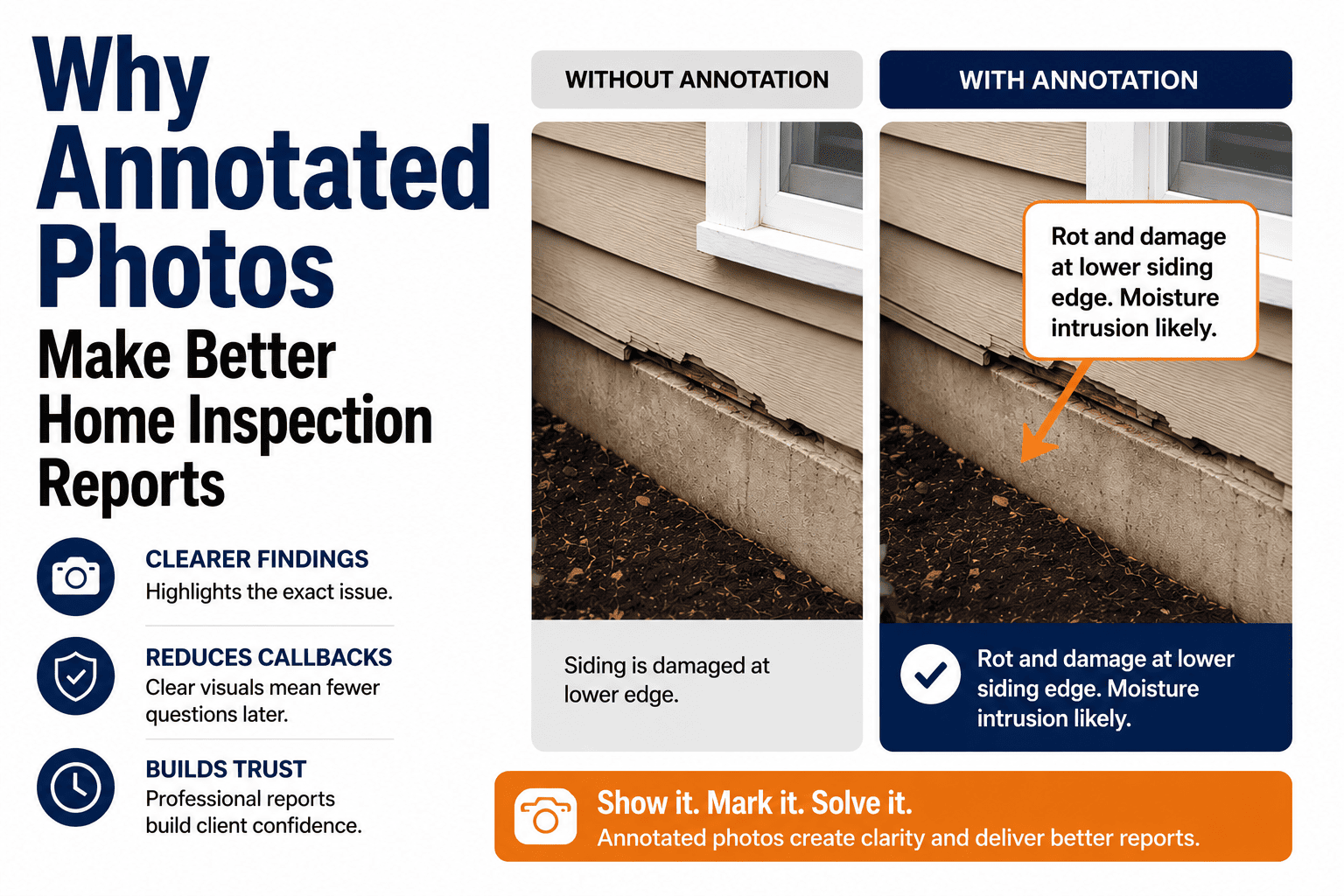
Include a coin or ruler for scale. If a crack worsens later, photos prove what it looked like during your inspection.
If storage blocked access, say so. You can't be liable for what you couldn't see.
Be specific: "northwest corner, 3 feet from floor" not just "basement wall." Clients need to find it.
"Sharp edges" = newer crack. "Weathered/painted edges" = older, likely stable. These details matter.
Frequently Asked Questions
When should I definitely recommend a structural engineer?
Always recommend engineer evaluation for: horizontal cracks (any width), cracks wider than 1/4", cracks with visible displacement or offset, wall bowing or bulging, or when foundation cracks are accompanied by multiple interior symptoms (sticking doors, sloping floors, drywall cracks). These patterns indicate potential structural movement that exceeds your scope to diagnose.
How do I avoid being an "alarmist" while still protecting myself?
Focus on describing what you observe factually, explaining the potential implications, and making appropriate recommendations. For minor cracks, "monitor for changes" is sufficient. For concerning cracks, "recommend evaluation by a licensed structural engineer" transfers responsibility appropriately without using alarming language like "structural failure" or "dangerous condition."
Should I measure every crack precisely?
Exact measurement isn't necessary—estimates are acceptable. Use reference comparisons: "less than 1/8 inch (thinner than a dime)" or "approximately 1/4 inch (pencil width)." The key thresholds are 1/8" (typically cosmetic below, monitor above) and 1/4" (usually warrants professional evaluation above). Include a photo with a coin for scale.
What if the basement is finished and I can't see the foundation?
Document the limitation clearly: "Foundation walls were not visible due to finished basement walls. Inspection limited to accessible areas." Then report any interior symptoms you observe (drywall cracks, sticking doors, floor slopes) and note that these could indicate foundation issues hidden behind finishes. This protects you while informing the client.
How do I handle pressure from agents to downplay crack findings?
Your report protects the client—and you. A $300-500 engineer evaluation is far less expensive than a $50,000 foundation repair the client didn't know about. Report what you observe accurately, make appropriate recommendations, and let the client and their agent decide how to proceed. Your job is to inform, not to facilitate the sale.
Report Foundation Cracks with Confidence
HomeInspecto gives you pre-built narratives for every crack scenario, photo annotation tools, and professional reports that protect you while serving your clients.
- Foundation crack narrative library
- Photo tools with measurement overlay
- Works offline on mobile
- 7-day free trial