
You climb down from the roof with your camera full of photos. Missing shingles, damaged flashing, granule lossall documented. But when you sit down to write the report, which photos matter most? How do you label them so clients understand what they're looking at? And what narrative ties it all together without sounding repetitive? This guide gives you a systematic framework for documenting roof findings with photos that protect you and inform your clients.
What Photos Do You Need for a Complete Roof Finding?
Every complete roof finding needs three types of photos: (1) Close-up detail showing the specific defect, (2) Medium context shot showing where on the roof it's located, and (3) Wide overview establishing which section/slope. Label each photo clearly: "South Slope - Missing Shingles (Detail)" and "South Slope - Missing Shingles (Location)." Pair photos with narratives that describe what you observed, where it's located, the likely impact, and what action is recommended.
Want photo labeling built into your workflow? HomeInspecto automatically organizes and labels inspection photos by location and defect type. See how it works →
Why Photos Aren't Enough on Their Own
Photos document what you saw. But without clear labeling and written context, they create more questions than they answer. Clients see a close-up of damaged shingles and wonder: Where is that? How big is the problem? Do I need a new roof or just a repair? Your job is to connect the visual evidence to actionable information.
Photos Show Evidence
Visual proof of what you observed during the inspection
Labels Add Location
Tell clients exactly where the problem is on the roof
Narratives Explain Impact
Describe severity, cause, and recommended next steps
The 3-Photo Framework for Every Roof Finding
Use this three-level approach to document any roof defect. Not every finding needs all three, but starting with this structure ensures you don't miss critical context.
Close-Up Detail
Zoomed shot showing the specific defect clearly
Medium Context
Shows defect plus surrounding area for reference
Wide Overview
Establishes which slope/section of the roof
Photo Labeling Best Practices
Good labels answer three questions: What am I looking at? Where is it? What level of detail am I seeing? Use this structure:
Common Labeling Mistakes
"IMG_2847.jpg"
Generic camera filename tells the client nothing
"Roof Damage"
Too vague—what kind of damage? Where?
"Photo 1, Photo 2, Photo 3"
Sequential numbers don't describe content
"Bad Shingles Left Side"
Ambiguous—left from street view or inside looking out?
Sample Narratives by Defect Type
Here are copy-and-adapt narratives for common roof findings. Each includes what to observe, how to photograph it, and what to write.
What to Photograph
- Close-up of exposed roof deck or underlayment
- Context showing how many shingles are missing
- Overview establishing location on the roof
Sample Narrative
Finding: Multiple shingles are missing on the south-facing slope near the ridge line. Approximately 8-10 shingles are absent in a 6-foot section, exposing the underlying felt paper to weather. No visible water damage to the deck was observed at the time of inspection, but the exposed area is vulnerable to moisture intrusion.
Recommendation: Recommend prompt repair by a qualified roofing contractor. Missing shingles should be replaced and surrounding shingles inspected for wind damage. Monitor interior ceilings below this area for signs of water staining.
What to Photograph
- Detail of damaged, rusted, or improperly sealed flashing
- Context showing flashing location (chimney, valley, penetration)
- Any visible water staining or damage nearby
Sample Narrative
Finding: The step flashing along the west-side chimney shows signs of deterioration and improper installation. Several flashing pieces are lifted, rusted through, or missing sealant. Water staining is visible on the chimney masonry below the damaged flashing sections.
Recommendation: Recommend evaluation and repair by a licensed roofing contractor. Chimney flashing should be properly installed with counter-flashing embedded in mortar joints. Interior inspection of adjacent spaces recommended to check for water intrusion.
What to Photograph
- Close-up showing bare spots or color variation
- Accumulation of granules in gutters or downspouts
- Overview showing extent across the roof surface
Sample Narrative
Finding: Moderate to heavy granule loss observed on the south and west-facing slopes. Shingles in these areas show significant wear with exposed asphalt visible in multiple locations. Heavy granule accumulation noted in gutters and at downspout discharge points. Based on appearance and granule loss pattern, the roof is nearing the end of its serviceable life.
Recommendation: Recommend budgeting for roof replacement within 1-3 years. While the roof is currently functional, continued granule loss will accelerate shingle deterioration and increase vulnerability to leaks. Obtain evaluation from licensed roofing contractors for replacement planning and cost estimates.
What to Photograph
- Blocked or insufficient intake vents (soffits)
- Missing or inadequate exhaust vents (ridge, gable)
- Any visible moisture damage in attic from poor ventilation
Sample Narrative
Finding: Roof ventilation appears inadequate. Soffit vents are blocked by insulation in multiple areas, and only one small gable vent provides exhaust ventilation for the entire attic space. Attic temperature at time of inspection (afternoon, moderate weather) was notably elevated. Moisture staining observed on roof sheathing near the ridge line, consistent with condensation from inadequate ventilation.
Recommendation: Recommend evaluation by a roofing or ventilation specialist. Proper intake and exhaust ventilation should be installed per manufacturer specifications and building codes. Adequate ventilation extends roof life, reduces cooling costs, and prevents moisture damage to structural components.
What to Photograph
- Profile view showing sag or dip in roof line
- Interior attic view of affected rafters/trusses if accessible
- Multiple angles to establish extent of structural issue
Sample Narrative
Finding: A noticeable sag is present in the roof deck on the east-facing slope, approximately 15 feet from the ridge line. The sag spans roughly 8 feet horizontally and appears to dip approximately 2-3 inches below the plane of the surrounding roof surface. From the attic, several rafters in this area show signs of stress, with one rafter exhibiting a visible crack. No active leaks observed, but the structural integrity of the roof deck is compromised.
Recommendation: Recommend immediate evaluation by a licensed structural engineer or qualified roofing contractor. Sagging roof deck indicates potential failure of framing members, inadequate support, or long-term water damage. Structural repairs may be necessary before roof covering can be addressed.
What to Photograph
- Areas of visible moss or algae growth
- Shaded sections where growth is concentrated
- Any associated shingle lifting or damage
Sample Narrative
Finding: Moss growth observed on the north-facing slope, concentrated in shaded areas beneath overhanging tree branches. Moss is present in scattered patches totaling approximately 15-20% of the slope area. Some shingle edges are slightly lifted where moss has established. No significant shingle damage or granule loss directly attributable to the moss at this time.
Recommendation: Recommend professional roof cleaning to remove moss and prevent further growth. Trim overhanging tree branches to increase sunlight exposure and reduce moisture retention. Consider installation of zinc or copper strips at the ridge to inhibit future moss growth. Monitor cleaned areas annually for recurrence.
Need 50+ pre-written roof narratives? HomeInspecto includes complete finding libraries for every common roof defect. Start your free trial →
Organizing Photos in Your Report
How you arrange photos in the report affects how easily clients can follow your findings. Use these strategies:
Group by Roof Section
All north slope findings together, all south slope findings together. Matches how roofers quote repairs.
Order by Priority
High-priority findings first (missing shingles, damaged flashing), maintenance items last (cleaning, minor repairs).
Use Photo Pairs
Place detail and context photos side-by-side. Clients see what and where simultaneously.
Number Systematically
If using numbers, make them meaningful: "Photo 1.1, 1.2, 1.3" for one finding keeps related images together.
Quick Reference: Photo Checklist by Defect
See Photo Organization in Action
Watch how HomeInspecto automatically groups roof photos by section and pairs detail shots with context images—no manual sorting required.
Schedule 15-Min DemoCommon Photo Mistakes That Confuse Clients
Too Many Similar Shots
Five photos of the same missing shingle from slightly different angles adds no value. Pick the clearest one and move on.
No Sense of Scale
A close-up of a crack looks identical whether it's 2 inches or 2 feet. Include context or use a measuring tool in the frame.
Unlabeled or Generically Labeled
"Roof Photo 1" tells the client nothing. "South Slope - Damaged Flashing at Chimney (Detail)" tells them everything.
Photos Without Written Findings
Photos alone don't explain severity, cause, or what to do next. Always pair images with clear narratives.
Poor Lighting or Focus
Blurry or dark photos undermine your credibility. Take time for proper lighting and focus, or retake the shot.
Frequently Asked Questions
How many photos should I take per roof defect?
For most defects, 2-4 photos is ideal: one close-up detail, one context shot showing location, and optionally a wide overview or secondary angle. Minor issues might need only 1-2 photos, while complex problems (major structural damage, extensive water intrusion) might warrant 5-6 to fully document the condition and extent.
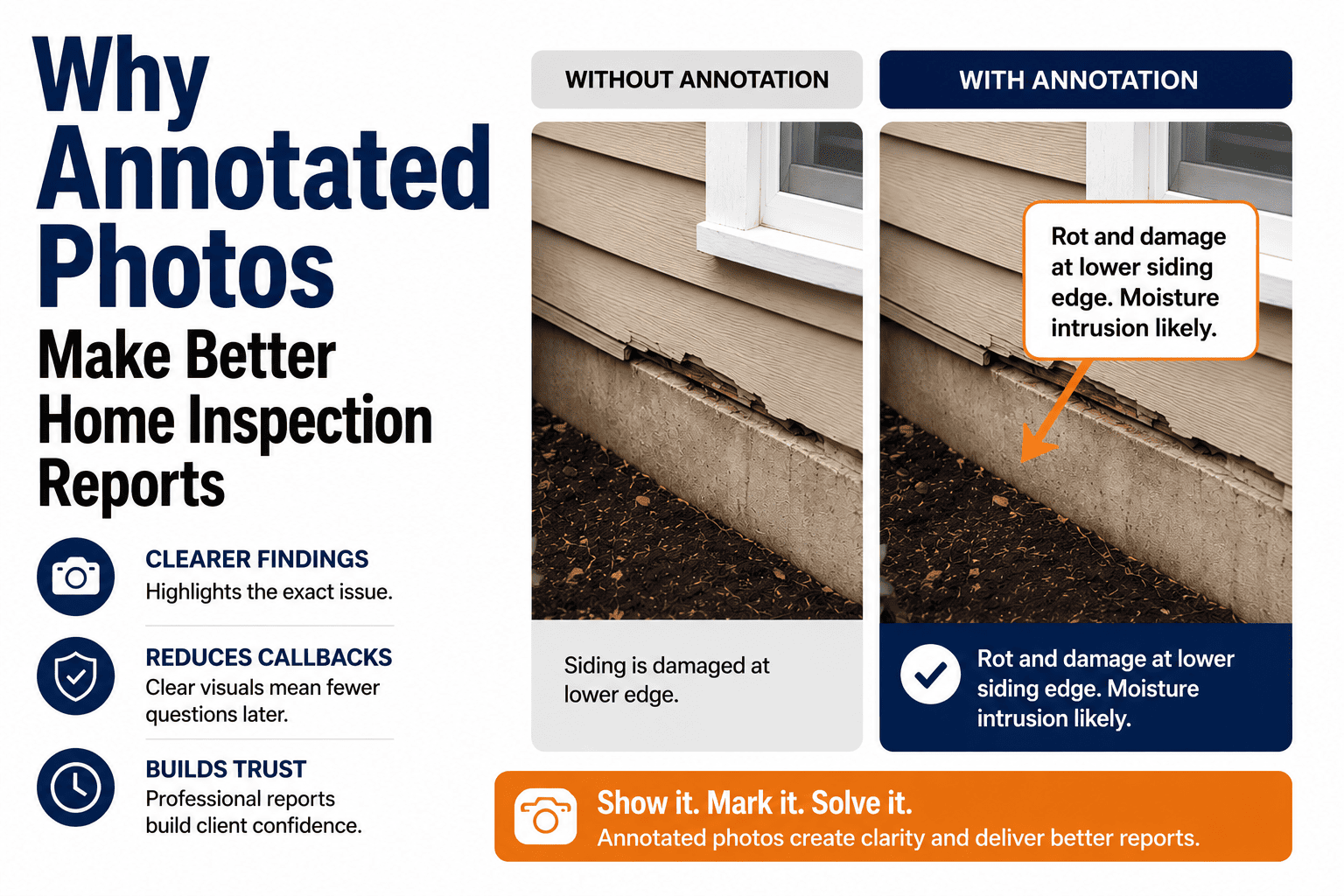
Should I mark up photos with arrows or annotations?
Annotations can help, but use them sparingly and professionally. A single arrow pointing to a specific crack or missing shingle clarifies what you're highlighting. Avoid cluttering the image with excessive markup—let clear labeling and written narratives do most of the explaining. Some software tools offer built-in annotation features that maintain a clean, professional look.
What if I can't safely access part of the roof to photograph a defect?
Safety always comes first. Document what you can see from safe vantage points (ground level, ladder at eave, adjacent structures). State clearly in your report: "The [section] could not be accessed due to [safety concern]. Recommend evaluation by a qualified roofing contractor with proper equipment." Use binoculars or zoom photography when possible, and always note limitations in your inspection scope.
How do I photograph roof issues in poor weather or lighting?
If conditions prevent clear photography, note it in your report and consider rescheduling the roof portion if feasible. When you must proceed, use your camera's flash sparingly (it can wash out detail), increase ISO for low light, and stabilize shots. Document the conditions in your report: "Roof inspection conducted in overcast conditions; some detail may be obscured in photos." Consider returning for supplemental photos if critical defects need better documentation.
Do I need to include interior attic photos for every roof finding?
Not for every finding, but interior attic photos are valuable for: (1) any exterior defect where water intrusion is likely (damaged flashing, missing shingles), (2) structural issues (sagging deck, cracked rafters), and (3) ventilation concerns. If you observe moisture staining, mold-like growth, or damaged sheathing corresponding to an exterior defect, document it. This shows the full extent and confirms the impact of exterior conditions.
Never Miss a Roof Finding Again
Join 500+ inspectors using HomeInspecto for systematic roof documentation with photos, narratives, and automatic organization—all from your mobile device on the roof.
No credit card required • Full access • Cancel anytime