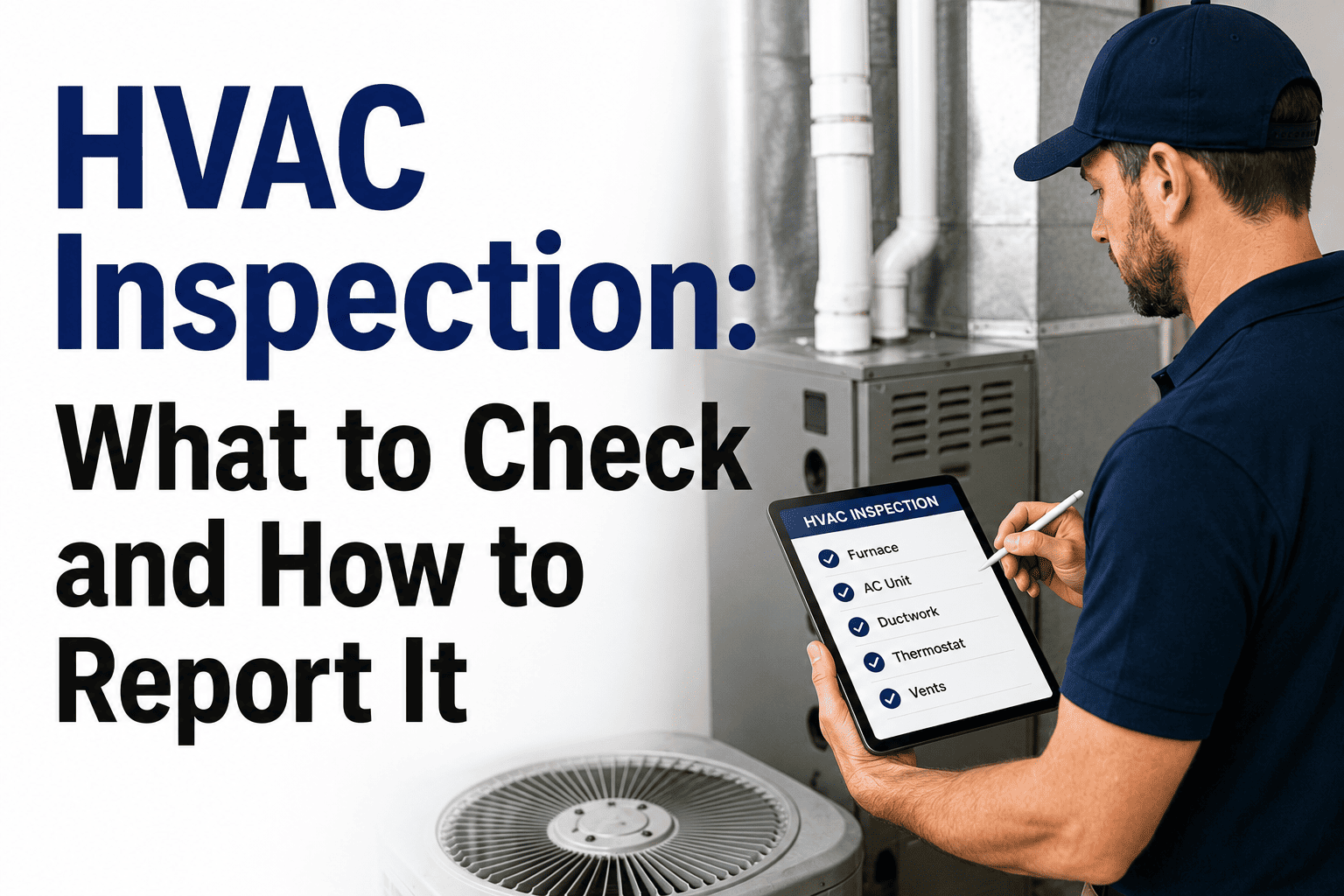

HVAC systems are complex, and documenting them clearly can make or break your inspection report. Whether you're noting a dirty filter, condensate drainage issue, or recommending service, the right language protects you and informs your clients. This guide provides ready-to-use narratives for every common HVAC finding you'll encounter.
HVAC System Types at a Glance
Different HVAC systems have different inspection priorities. Know what to look for based on the system you're evaluating:
Split System
Gas Furnace
Heat Pump
Pre-written HVAC narratives ready to use. HomeInspecto includes complete HVAC comment libraries for instant report generation. Schedule a demo →
Filter Condition: Most Common Finding
Filters are the first thing clients notice and the easiest defect to document. A dirty or missing filter can lead to system damage, poor air quality, and reduced efficiency. Here's how to write it up:
Clean/New Filter
Filter appears recently replaced or in good condition with minimal debris accumulation.
"The HVAC filter was inspected and found to be clean/recently replaced. Filter size: [20x25x1]. Recommend regular replacement per manufacturer guidelines (typically every 1-3 months)."
Dirty Filter
Filter shows significant debris accumulation restricting airflow.
"The HVAC filter is dirty and restricting airflow. This condition reduces system efficiency, increases energy costs, and can lead to premature equipment failure. Recommend immediate replacement and regular maintenance schedule."
Missing Filter
No filter installed—debris entering system and coating evaporator coil.
"No HVAC filter is installed. Operating without a filter allows dust and debris to accumulate on the evaporator coil and blower components, reducing efficiency and potentially damaging the system. Recommend installing proper filter immediately."
Wrong Size Filter
Filter doesn't fit properly—gaps allowing unfiltered air bypass.
"The HVAC filter is undersized for the filter housing, allowing unfiltered air to bypass the filter. This reduces filtration effectiveness and allows debris to enter the system. Recommend installing correctly sized filter."
Condensate Drainage Issues
Condensate problems are a leading cause of water damage and mold growth. Document these issues carefully with specific language:
Signs of Condensate Problems
Common Condensate Defects
- Clogged drain line — Blocked with algae, debris, or sediment
- Improper slope — Drain line not pitched for gravity flow
- Missing trap — Required for negative pressure systems
- Rusted drain pan — Corrosion causing leaks
- Disconnected drain — Line separated from pan or termination
- Improper termination — Draining into unacceptable location
- No secondary drain/float switch — Missing backup protection
Condensate Defect Narratives
Active Water Leak
Water actively leaking from unit or condensate system causing immediate damage risk.
"Active water leak observed at the HVAC air handler. Water is dripping from [location] causing damage to surrounding materials. Recommend immediate service by a qualified HVAC technician to prevent further water damage."
Clogged Drain Line
Condensate drain line blocked—water backing up into drain pan.
"The condensate drain line appears clogged. Standing water was observed in the drain pan, indicating improper drainage. This condition can lead to overflow, water damage, and mold growth. Recommend clearing the drain line and verifying proper flow."
Rusted Drain Pan
Secondary drain pan shows corrosion that may lead to leaks.
"The secondary condensate drain pan beneath the air handler shows significant rust and corrosion. This pan serves as backup protection against water damage. Recommend replacement before pan integrity is compromised."
No Float Switch
No overflow protection device installed on drain pan.
"No float switch or overflow protection device is installed on the condensate drain pan. A float switch shuts down the system if the pan fills, preventing water damage. Consider adding this safety device, especially for units located in attics or above living spaces."
Airflow Issues & Temperature Differential
Proper airflow is essential for HVAC efficiency. Document airflow issues with specific measurements when possible:
Temperature Differential Guidelines
Pro Tip: Always document the actual temperatures measured at supply and return registers, along with the calculated differential. Low differential may indicate low refrigerant, dirty coils, or restricted airflow.
Common Airflow Defects
Low Temperature Differential
"Temperature differential measured at [X]°F (supply: [X]°F, return: [X]°F). Normal cooling differential is 14-22°F. Low differential may indicate low refrigerant charge, dirty evaporator coil, or restricted airflow. Recommend evaluation by a qualified HVAC technician."
Weak/No Airflow at Register
"Little to no airflow detected at the supply register in [room]. This may indicate a blocked or disconnected duct, closed damper, or blower issue. Recommend further evaluation to identify the cause."
Dirty Supply Registers
"Supply registers throughout the home show significant dust accumulation. While not affecting immediate function, this may indicate dirty ductwork or inadequate filtration. Recommend cleaning registers and evaluating duct condition."
Return Air Restricted
"The return air grille is partially blocked by [furniture/debris]. Restricted return air reduces system efficiency and can cause premature equipment wear. Recommend maintaining clear space around return air grilles."
Age Assessment & Service Recommendations
Knowing when to recommend service versus replacement is critical. Use these guidelines and narratives:
Equipment Age Decoding
Most manufacturers encode the manufacture date in the serial number:
2519... = Week 25, 2019
First 4 digits = week + year
194523... = 2019, Week 45
Digits in specific positions indicate date
5819... = 2019
First 2 or 4 digits indicate year
Tip: Use the Building Intelligence Center website to decode serial numbers for any manufacturer.
Age-Related Narratives
"The HVAC system was manufactured in 2020 (approximately 5 years old). The system operated normally at the time of inspection. With proper maintenance, this equipment should provide several more years of service."
"The HVAC system was manufactured in 2012 (approximately 13 years old). While functional at the time of inspection, the unit is approaching the end of its typical service life (15-20 years). Budget for replacement in the coming years and maintain annual service."
"The HVAC system was manufactured in 2003 (approximately 22 years old), which exceeds the typical 15-20 year service life. While operational at the time of inspection, replacement should be anticipated. The system also uses R-22 refrigerant, which is no longer manufactured."
HVAC Service Recommendation Language
Use these professionallyworded service recommendations based on your findings:
Routine Maintenance
"Recommend annual HVAC maintenance service to ensure continued efficient operation, identify potential issues early, and extend equipment life."
When: No defects found, general recommendationService Before Closing
"Recommend service by a qualified HVAC technician prior to closing to evaluate [specific concern] and ensure proper operation."
When: Minor defects or concerns notedImmediate Service Required
"The HVAC system requires immediate service by a qualified technician. Do not operate until [issue] has been evaluated and corrected."
When: Safety concerns or major defectsReplacement Recommended
"Given the age and condition of the HVAC system, replacement should be anticipated. Recommend obtaining estimates from qualified HVAC contractors."
When: Equipment beyond useful lifeComplete HVAC narrative library included. HomeInspecto auto-generates age estimates and recommends appropriate service language based on system condition. Start your free trial →
Photo Documentation Checklist
The right photos protect you and help clients understand issues. Capture these for every HVAC inspection:
Data Plate
Shows model, serial number, capacity, and efficiency rating. Essential for age verification.
Filter Condition
Document filter condition and size. Show dirty filters clearly.
Condensate Pan & Drain
Show pan condition, drain connection, and any water accumulation.
Outdoor Unit
Overall condition, clearances, refrigerant lines, and electrical disconnect.
Thermostat
Settings, temperature display, and any error codes.
Temperature Readings
Your thermometer at supply and return showing measured temps.
Ductwork (Visible)
Condition, connections, insulation, and any damage visible.
Any Defects
Close-ups of rust, damage, leaks, or other issues found.
Frequently Asked Questions
Should I test both heating and cooling modes?
Test all modes available for the conditions. Avoid testing cooling when outdoor temps are below 60°F (can damage the compressor) and heating when indoor temps are already high. Document which modes were tested and why any modes were not tested. Example: "Cooling mode not tested due to outdoor temperature below 60°F—could damage compressor."
How do I report a system that won't start?
Document what you observed and attempted: "The HVAC system did not respond when the thermostat was set to [heat/cool]. Verified thermostat was set correctly and temperature differential was adequate to trigger operation. System may have a failed component, tripped breaker, or other issue. Recommend evaluation by a qualified HVAC technician."
What if the system uses R-22 refrigerant?
R-22 (Freon) was phased out January 1, 2020. Note this in your report: "The air conditioning system uses R-22 refrigerant, which is no longer manufactured. If a refrigerant leak develops or service is needed, repairs may be cost-prohibitive due to limited R-22 availability. Consider this when planning for future replacement."
Should I note the SEER rating?
Yes, if visible on the data plate. Higher SEER = more efficient. Current minimum is 14-15 SEER depending on region. Example: "The air conditioning system is rated at 10 SEER. Current minimum efficiency standards require 14-15 SEER for new installations. Upgrading to a higher-efficiency system would reduce cooling costs."
How should I document unusual noises?
Be specific about the noise type and location: "A [grinding/squealing/rattling/banging] noise was heard coming from the [indoor unit/outdoor unit/ductwork] during operation. This may indicate [worn bearings/loose components/duct expansion/etc.]. Recommend evaluation by a qualified HVAC technician to identify the source."
Professional HVAC Documentation
HomeInspecto includes complete HVAC workflows with pre-written narratives and automatic report generation.
- Filter & condensate defect library
- Temperature differential calculator
- Age lookup tools
- Mobile inspection app