
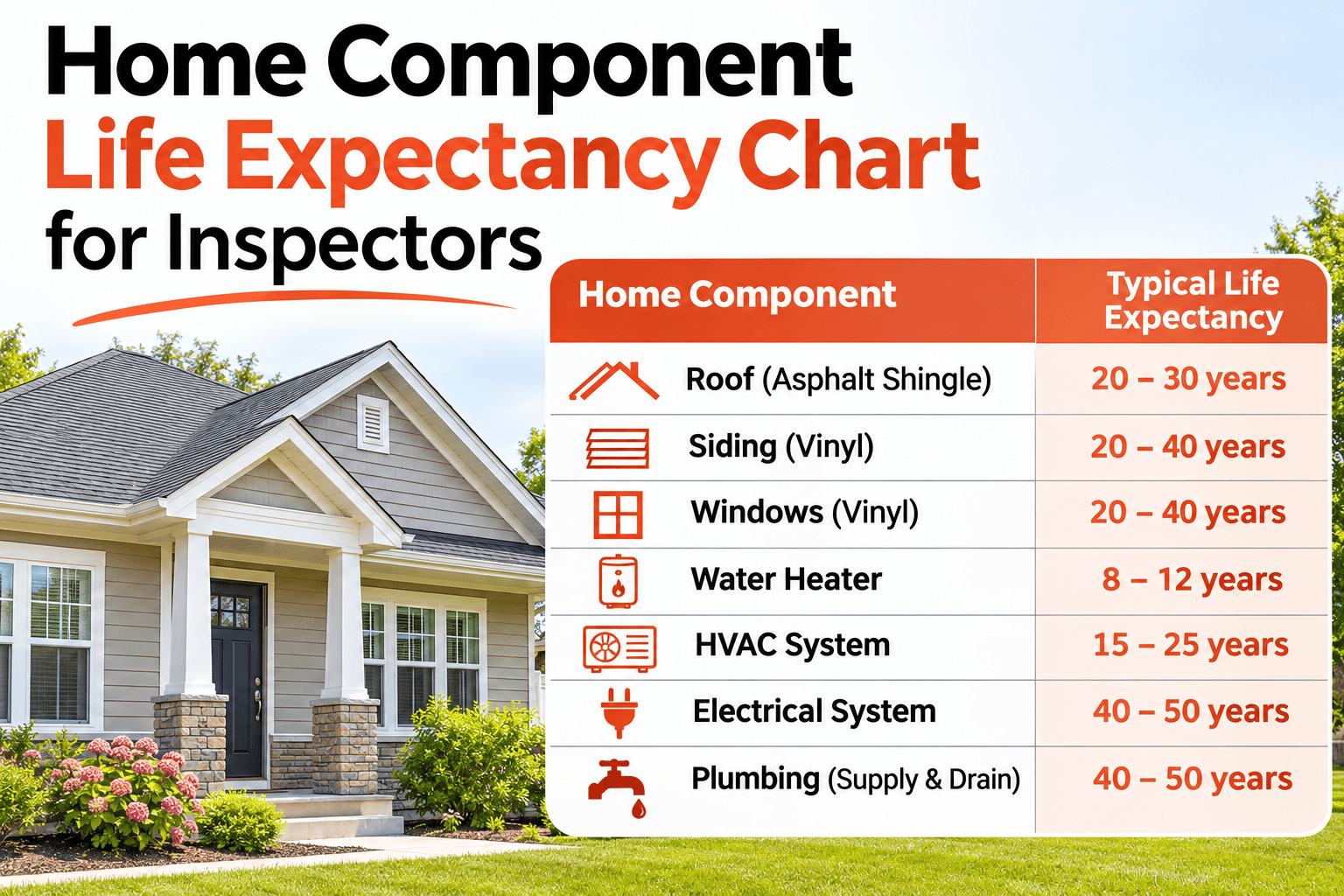
Every buyer asks the same question an inspector can't answer with a yes or no: how long will the roof last, or the furnace, or the water heater? A life expectancy chart turns that into a number you can plan around — a typical lifespan for each major system, set against its age, to estimate what's left. This guide lays out the chart by category and shows how to fold remaining-life estimates into a report without promising a date. Build life-expectancy notes into HomeInspecto.
Home inspection guide
Home component life expectancy chart for inspectors
Typical lifespans for the systems buyers worry about — the basis for a remaining-life estimate on any component.
Why a life expectancy chart matters
An inspection reports condition today; a lifespan estimate points at tomorrow. Together they tell a buyer which systems are near the end and what to budget for.
-
Remaining life
Age against a typical lifespan gives a rough estimate of the years a component has left.
-
Budgeting
A buyer can plan for the roof or furnace that's due, instead of being surprised by it.
-
Negotiation
A documented end-of-life system becomes a fair point in the conversation before closing.
The life expectancy chart
Typical lifespans drawn from industry references. Treat each as a planning range, not a promise — actual life depends on quality, climate, and maintenance.
Roofing
- Asphalt shingles (3-tab)15–30 yrs
- Architectural shingles~30 yrs
- Wood shakes~30 yrs
- Metal roofing40–80 yrs
- Tile, slate, or copper50–100 yrs
Heating & cooling
- Gas furnace15–20 yrs
- Heat pump~16 yrs
- Central air conditioning7–15 yrs
- Boiler~40 yrs
- Ductwork30–50 yrs
- Thermostat~35 yrs
Water heaters & plumbing
- Water heater (tank)6–12 yrs
- Water heater (tankless)20+ yrs
- Cast iron waste pipe50–60 yrs
- PVC or ABS waste pipe50–80 yrs
- Faucets & fixtures15–20 yrs
- Toilet50+ yrs
Windows, doors & exterior
- Vinyl or wood windows20–40 yrs
- Aluminum windows15–20 yrs
- Wood deck~15 yrs
- Pressure-treated deck10–30 yrs
- Vinyl siding60+ yrs
- Garage door20–25 yrs
Appliances
- Refrigerator~13 yrs
- Range or oven13–15 yrs
- Dishwasher~9 yrs
- Clothes washer~10 yrs
- Clothes dryer~13 yrs
- Microwave~9 yrs
The ranges are wide for a reason — a maintained metal roof outlives a neglected one by decades. See the chart built into a report in a demo.
Put a remaining-life number on every system
Record each component's age, pull its typical lifespan, and hand the buyer a realistic replacement timeline alongside the condition notes.
How to use remaining life in a report
The estimate is most useful tied to the component finding, in plain terms a buyer can act on.
- 1Record the age. From the data plate, permit, or visible wear — note how you estimated it.
- 2Set it against the lifespan. Age versus the typical range gives an approximate remaining life.
- 3Flag what's near the end. Call out systems within a few years of their range so they stand out.
- 4Frame it as an estimate. Say it's a planning range, not a prediction of failure on a date.
"Approximately 2 to 4 years of remaining life" helps a buyer; "fails next year" oversteps what anyone can know. Add remaining-life fields in HomeInspecto.
What the numbers don't tell you
A lifespan is a starting point, not a guarantee. Four things move it in either direction.
- Climate — UV, heat, humidity, and freeze cycles all shorten exterior components
- Maintenance — a flushed water heater and a cleared gutter buy years
- Quality — a builder-grade unit and a premium one age differently
- Use — heavy household use wears appliances faster than the average
Coastal and high-humidity regions run shorter, which is why some references keep a separate chart for them. See the caveats built into the wording in a demo.
How HomeInspecto handles life expectancy
-
Age fields per system
Record roof, HVAC, and water-heater age against each component note.
-
Built-in lifespan ranges
Typical lifespans on hand, so a remaining-life estimate is one step.
-
Near-end flags
Systems close to their range stand out in the summary.
-
Estimate-safe wording
Language that frames remaining life as a planning range, not a date.
-
Buyer-ready export
A report that pairs condition with a realistic replacement timeline.
-
Record per property
Ages and estimates stay on file for the next owner's planning.
Condition and timeline, in one report. Book a demo on your own template.
Frequently asked questions
How long do major home systems last?
Roughly: asphalt roofs 15 to 30 years, metal 40 to 80; gas furnaces 15 to 20; central AC 7 to 15; tank water heaters 6 to 12. Ranges are wide and depend on maintenance and climate. See the full chart in a quick demo.
How do inspectors estimate remaining life?
By setting the component's age against its typical lifespan range. It's an estimate, not a prediction — a 10-year-old tank water heater is near the end of a 6-to-12-year range, for example.
How long does a roof last?
It depends on the material: 3-tab asphalt shingles 15 to 30 years, metal 40 to 80, and tile or slate 50 to 100. Climate and maintenance shift it either way — start a free trial to track it.
When should a water heater be replaced?
A common rule of thumb is to plan for replacement once a tank water heater passes about 12 years, though many last longer. Rusty water, rumbling, and leaks are signs it's near the end.
Are these lifespans guaranteed?
No. They're research-based estimates, and quality, climate, maintenance, and use all move the number. A report should frame remaining life as a planning range. See how it's worded in a demo.
Condition today, timeline tomorrow
Give every system a remaining-life estimate
Age fields, built-in lifespan ranges, near-end flags, and estimate-safe wording — the chart, built into the report.


