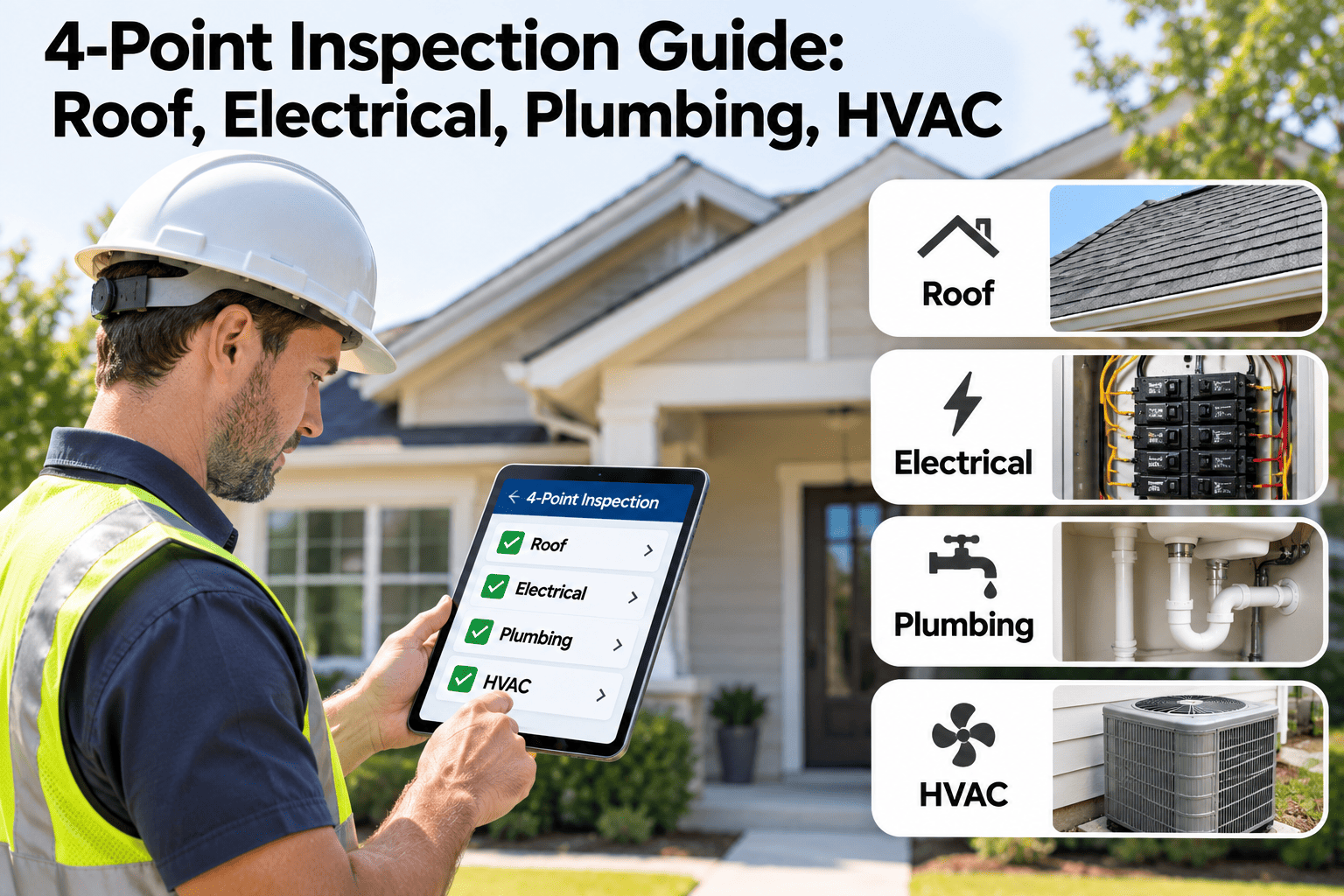
A buyer is days from closing, or a homeowner is up for renewal, and the carrier asks for one specific document: a 4-point inspection. It is not a full home inspection and it is not a wind mitigation report — it answers a single underwriting question across four systems, roof, electrical, plumbing, and HVAC. Get those four right, photograph them properly, and the policy moves forward. Run your 4-point reports in HomeInspecto.
Specialty inspection guide
The 4-point inspection: four systems, one insurance decision
Older homes almost always trigger it. Here is exactly what each of the four systems is judged on, what fails most often, and the photos a carrier needs to say yes.
- RRoof
- EElectrical
- PPlumbing
- HHVAC
Why carriers ask for it — and when
A 4-point exists to answer one yes-or-no question: is this home insurable right now? Carriers zero in on the four systems that drive the most expensive claims, because those are the ones that age out quietly on older houses.
The four systems, up close
Each system is recorded for type, age, and condition — and each has a short list of findings that make underwriters nervous.
-
RRoof
Recorded: covering type, age, condition, and estimated remaining life.
Flags: a roof with fewer than the 5 years of life underwriters typically want, active leaks, or visible patchwork.
-
EElectrical
Recorded: panel brand and amperage, wiring type, condition, and any safety hazards.
Flags: Federal Pacific, Zinsco, or Challenger panels; knob-and-tube or aluminum branch wiring; fuses; double-tapped breakers.
-
PPlumbing
Recorded: supply material, drain material, water heater age, and any sign of past or active leaks.
Flags: polybutylene supply lines, aged galvanized or cast iron, and a water heater near end of life.
-
HHVAC
Recorded: system type, approximate age, operational status, and visible condition.
Flags: a unit past roughly 20 years, a system that does not run, or missing heat or cooling.
The pattern is the same across all four: age and condition, backed by a dated photo. Capture every system on one mobile form with HomeInspecto.
What actually fails a 4-point
A handful of findings account for most declines. These are the ones worth checking before the inspector arrives.
- 1Recalled electrical panels. Federal Pacific Stab-Lok, Zinsco, and increasingly Challenger panels are often declined outright until replaced, regardless of apparent condition.
- 2Polybutylene plumbing. The single most common plumbing red flag — these supply lines can fail and many carriers will not write over them.
- 3A roof near the end of its life. Fewer than about 3 to 5 years of remaining life, or active leaks, is a frequent decline.
- 4Hazardous wiring. Active knob-and-tube or single-strand aluminum branch wiring reads as a fire risk to underwriters.
- 5A non-functional or aged HVAC. A system that does not run, or is well past 20 years, can hold up binding.
Knowing these before the visit turns a surprise decline into a planned repair. Walk through a sample 4-point in a demo.
Deliver the 4-point the same day
Photograph each system, record age and condition, and hand the carrier a clean, labeled report before the deal cools.
The photos a carrier expects
A 4-point is a photo-driven document. Miss a required shot and the report bounces back for a return visit.
- Each side of the home, and each slope of the roof
- The electrical panel with its door open, and the cover removed
- The water heater, under-sink plumbing, and any exposed valves
- The HVAC equipment and its dated manufacturer's plate
- A close shot of any hazard or deficiency the report notes
One missing data plate is the difference between same-day and next-week. Build a required-photo checklist into every report.
Cost, time, and what it is not
- $50–150Typical cost, varying by state and home size
- 30–60 minA visual, non-invasive walkthrough
- Yes / noIt answers insurability, not repair detail
A 4-point is not a buyer's home inspection — it will not catch every defect in the house — and it is not a wind mitigation report, which documents roof straps and opening protection instead. Each is a separate document for a separate purpose. See how HomeInspecto handles all three in a demo.
How HomeInspecto gets the 4-point out fast
-
System-by-system template
Roof, electrical, plumbing, and HVAC laid out in order, so nothing in the four gets skipped.
-
Required-photo prompts
The form flags every carrier-required shot — panel open and off, data plates, roof slopes — before you leave the site.
-
Panel and pipe pick-lists
Tap the brand and material instead of typing, so FPE, Zinsco, or polybutylene is captured consistently every time.
-
Same-day report export
Turn the field record into a clean, carrier-ready document the moment you finish the walkthrough.
-
Age and life-left fields
Built-in prompts for roof life and equipment age keep the underwriting answer defensible.
-
One record per property
Every 4-point, photo, and note stays on file, ready for the renewal or the next owner.
Fewer return visits, faster binding, a report the carrier accepts the first time. Book a demo on your own workflow.
Frequently asked questions
What does a 4-point inspection cover?
Four systems only: the roof, electrical, plumbing, and HVAC. For each, the inspector records type, age, and condition. It is narrower than a full home inspection and exists to answer an insurance underwriting question. See the whole flow in a quick demo.
When do I need a 4-point inspection?
Most carriers require one once a home is roughly 20 to 30 years old, either to write a new policy or at renewal. Some high-risk markets ask for it sooner.
What fails a 4-point inspection?
Most often: a Federal Pacific or Zinsco panel, polybutylene plumbing, a roof near the end of its life, hazardous wiring, or a non-functional HVAC. Any one can hold up coverage. A clear photo record of each system is what keeps the report moving — start a free trial.
How much does a 4-point inspection cost?
Usually $50 to $150, depending on the state, the inspection company, and the size and age of the home. The visit itself is visual and typically takes 30 to 60 minutes.
Is a 4-point the same as a full home inspection?
No. A full inspection reviews the whole house for a buyer; a 4-point looks at four systems for an insurer. They serve different purposes, and one does not replace the other. HomeInspecto can run both — book a demo.
Four systems, one clean report
Turn every 4-point into a same-day, carrier-ready document
System templates, required-photo prompts, and instant export — so the policy binds on the first submission.