
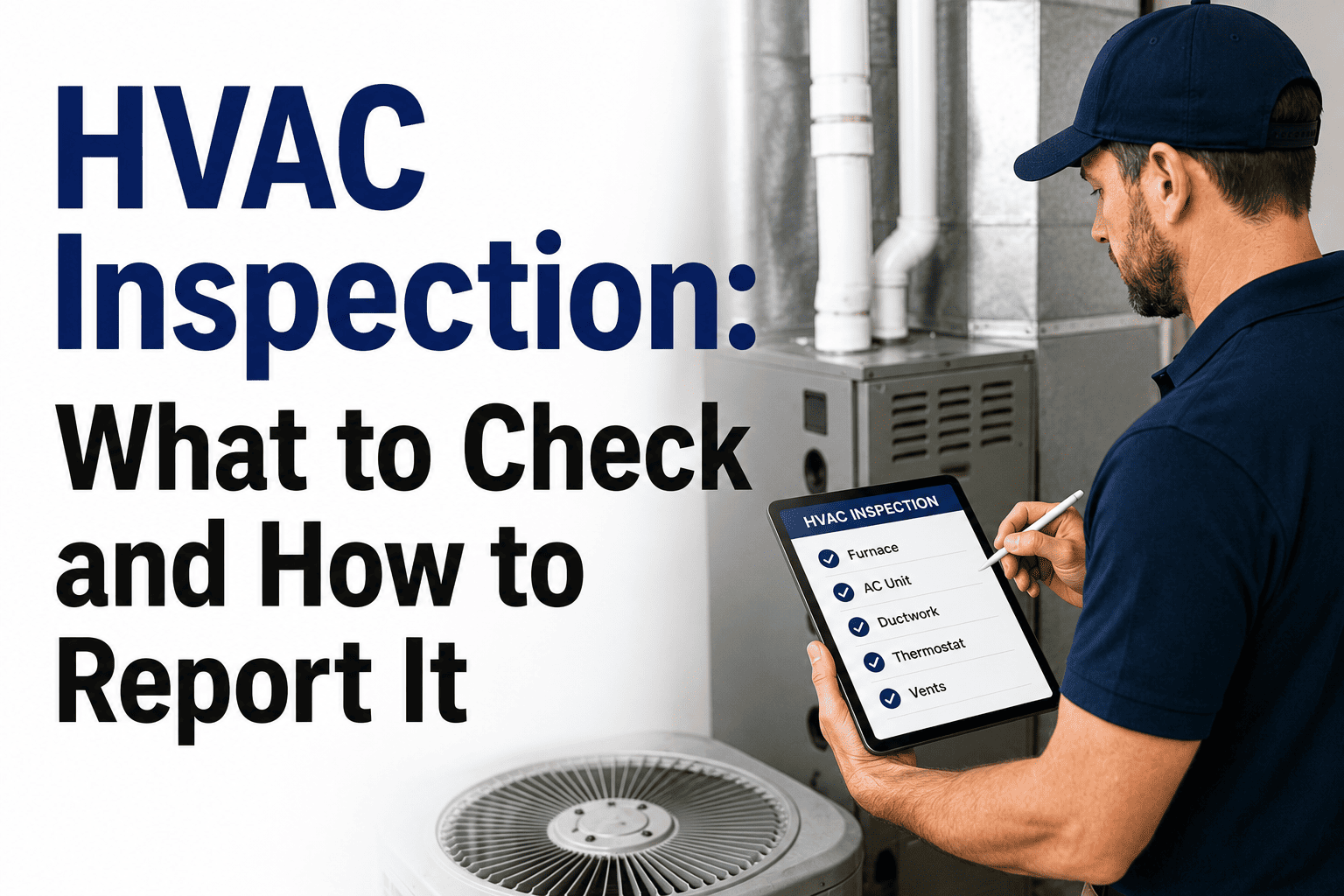
Heating and cooling systems account for roughly half of a home's energy consumption, and replacing them costs anywhere from $3,000 to $12,000. That makes the HVAC section one of the highest-stakes parts of any home inspection report — and one of the sections clients scrutinize most. A furnace that runs today can have a cracked heat exchanger, corroded burners, or a refrigerant type that makes future repairs prohibitively expensive. This guide covers exactly what to check on every HVAC inspection — heating, cooling, distribution, and controls — how to read equipment age from the data plate, how to flag end-of-life systems without overstepping your scope, and how to write HVAC findings that give the client real decision-making information. If you want to see how structured HVAC documentation looks inside a finished report, book a demo.
Defect Knowledge — HVAC Systems
HVAC Inspection: What to Check, What to Flag, How to Report It
Furnaces, air conditioners, and heat pumps are the most expensive systems in the house. Learn what inspectors evaluate, what falls outside your scope, and how to document findings that matter.
What Home Inspectors Evaluate — and What They Do Not
A home inspection is a visual, operational evaluation — not an HVAC diagnostic. Understanding the boundary keeps you within your scope of practice and helps you write findings that accurately represent what you observed without implying a level of testing you did not perform.
Within scope
Operate the system through normal controls
Note equipment age from the data plate
Check filter condition
Observe burner flame color (gas furnace)
Inspect visible flue and venting
Check accessible ductwork condition
Note refrigerant type from data plate
Identify visible rust, corrosion, or damage
Outside scope — refer to HVAC technician
Test refrigerant charge or levels
Perform combustion analysis
Inspect heat exchanger internally
Measure airflow at registers
Evaluate compressor mechanical health
Service or repair the system
The Heating System: What to Check
Whether the home has a gas furnace, electric furnace, boiler, or heat pump in heating mode, the inspection follows the same logic: operate the system, observe performance, and document condition. Gas furnaces require extra attention because of combustion safety concerns.
Equipment identification
Photograph the data plate. Record manufacturer, model, serial number, fuel type, BTU rating, and manufacture date. The serial number encodes the manufacture year — use it to calculate equipment age even when the date is not printed directly.
Operational test
Set the thermostat to heating mode and verify the system fires, heats, and cycles off normally. Note any unusual sounds — banging, rattling, squealing — during startup, operation, and shutdown. Confirm warm air reaches supply registers.
Burner and flame (gas systems)
A healthy gas furnace produces a steady blue flame. Yellow or orange flame indicates incomplete combustion and a potential carbon monoxide risk. Look for soot or scorching on the burner assembly — signs of ongoing combustion problems.
Heat exchanger (visible portions)
Inspect what is visible through the burner opening or access panel. Look for cracks, rust, corrosion, or separation at seams. A cracked heat exchanger is a critical safety concern — carbon monoxide can leak into the living space. If you see signs, recommend immediate evaluation by an HVAC technician.
Flue and venting
Check that the flue pipe is intact, properly sloped, connected at all joints, and clear of obstructions. Look for rust, gaps, and signs of backdrafting (soot stains around the draft hood). Blocked or damaged venting is a carbon monoxide hazard.
Filter and blower
Note filter condition — a severely restricted filter reduces airflow and can cause the heat exchanger to overheat. Check that the blower runs, moves air, and does not produce grinding or squealing sounds that signal bearing failure.
The Cooling System: What to Check
Central air conditioners and heat pumps in cooling mode share the same inspection approach. One critical limitation: most standards of practice prohibit operating the cooling system when outdoor temperatures are below approximately 60 degrees Fahrenheit, because low temperatures can damage the compressor. Document the limitation if you cannot run the system.
Outdoor unit (condenser)
Check for physical damage, debris blocking airflow, bent fins, level pad or mounting, and adequate clearance around the unit. Note the data plate information — including refrigerant type. Units manufactured before roughly 2010 often use R-22, which is no longer produced and expensive to recharge.
Operational test
Set the thermostat to cooling mode and verify the compressor starts, the condenser fan runs, and cool air reaches supply registers. Note any unusual sounds, vibrations, or short-cycling behavior. Measure temperature differential at the supply and return if your process includes it — a 15 to 20 degree split is typical.
Refrigerant lines
Check that the insulation on the suction line (the larger, cold line) is intact. Damaged or missing insulation reduces efficiency. Look for oil stains at connections — a sign of possible refrigerant leak. You do not test refrigerant charge; that requires an HVAC technician.
Condensate drain
Verify the condensate drain line is connected and not clogged. A blocked drain causes water to back up into the drain pan and potentially onto floors, ceilings, or mechanical equipment. Check for secondary drain pan and overflow safety switch where present.
Pre-loaded HVAC comments save you from writing the same findings every time. HomeInspecto includes a reusable comment library covering common heating and cooling defects — so you tap, customize, and move on.
Distribution and Controls
Ductwork and controls are often overlooked, but they directly affect system performance and client comfort. A furnace that runs perfectly is meaningless if half the ductwork is disconnected in the crawlspace.
Ductwork
Inspect accessible supply and return ducts for disconnections, crushed sections, damaged insulation, and signs of condensation or mold growth. Note any sections wrapped in asbestos-containing insulation and recommend testing if suspected. Poorly sealed ductwork is one of the most common energy-loss findings in residential inspections.
Thermostat
Verify the thermostat controls both heating and cooling modes, displays accurately, and triggers the system to cycle on and off at the set temperature. Note whether it is a programmable or smart thermostat and whether it is properly located — placement near a heat source, direct sunlight, or exterior wall can cause false readings.
Registers and returns
Check that supply registers deliver conditioned air in each room and that return air registers are unblocked. Note rooms with no supply register — this is a comfort issue the client will notice immediately after moving in.
Flagging End-of-Life Equipment
One of the most valuable things you can do for a client is put HVAC age in context. A system that runs today may need replacement within the buyer's ownership window — and that replacement can cost thousands. Here is how to report it accurately without overstepping.
Report the age and the average lifespan
State the manufacture date and note the published average lifespan for that equipment type — 15 to 25 years for furnaces, 15 to 20 years for central AC, roughly 15 years for heat pumps. Let the client see where the system falls on that range. This is factual context, not a prediction of failure.
Flag R-22 refrigerant
If the data plate shows R-22 (HCFC-22), note it clearly. R-22 production ended in 2020 and remaining supply is limited and expensive. An R-22 system that develops a refrigerant leak faces repair costs that often exceed the value of the equipment. This is a material cost factor the buyer needs to know.
Describe observed condition, not predicted lifespan
Report what you see: rust on the burner assembly, corrosion on the condenser coils, a severely clogged filter, unusual sounds during operation. Combine visible condition with age to give context — but do not put a year on when the system will fail. That is the HVAC technician's call.
Recommend specialist evaluation when warranted
If the system is aged, shows signs of deferred maintenance, uses R-22, or presents any safety concern, recommend evaluation by a licensed HVAC technician. This referral is appropriate, professional, and within your scope. It protects the client and protects you.
Document What You See. Let the Report Speak for Itself.
HomeInspecto gives you HVAC-specific comment templates, in-app photo capture for data plates and defects, and a structured report that communicates age, condition, and recommendations clearly — so the client gets decision-quality information.
Frequently Asked Questions
What does a home inspector actually test on the HVAC system?
A home inspector operates the heating and cooling systems through normal controls, checks equipment age from the data plate, observes burner flame color on gas furnaces, inspects the filter, examines visible flue and venting, checks accessible ductwork, notes refrigerant type, and identifies visible rust, corrosion, or damage. Inspectors do not test refrigerant levels, perform combustion analysis, internally inspect the heat exchanger, or measure airflow at registers — those evaluations require a licensed HVAC technician.
How do I determine the age of an HVAC system?
The manufacture date is encoded in the equipment data plate, usually on a sticker on the unit's exterior panel. Some manufacturers print the date directly; others embed it in the serial number. Manufacturer websites and decoder tools can translate serial numbers into manufacture dates. Photograph the data plate on every inspection — it gives you the age, model, fuel type, capacity, and refrigerant type in one image.
What is the significance of R-22 refrigerant in an inspection?
R-22 was phased out of production in the United States as of January 2020. Systems that use R-22 still operate, but if they develop a refrigerant leak, recharging is expensive because the remaining supply is limited and declining. An R-22 system that needs refrigerant work should generally be considered at end of economic life — the repair cost often approaches or exceeds the cost of replacing the system with one that uses modern refrigerant. Note the refrigerant type from the data plate and include it in the report.
When should I recommend HVAC specialist evaluation?
Recommend a specialist when you observe signs of a potential cracked heat exchanger (soot, corrosion, visible cracks or separation), when the system is aged and shows deferred maintenance, when the flame color is yellow or orange, when the system uses R-22 refrigerant, when the flue or venting shows signs of backdrafting, or when the system fails to heat or cool adequately during your operational test. The referral is a service to the client — it triggers a deeper evaluation you are not equipped to perform.
Can I run the air conditioner in cold weather?
Most standards of practice advise against operating the cooling system when outdoor temperatures are below approximately 60 degrees Fahrenheit, because low ambient temperatures can damage the compressor. If you cannot run the system, note the limitation in your report and explain that the cooling system was not tested due to outdoor temperature conditions. This is a standard and accepted practice.
How does HomeInspecto help with HVAC documentation?
HomeInspecto includes pre-loaded HVAC comment templates covering common heating and cooling findings, in-app photo capture for data plates and defects, and a report structure that presents equipment age, condition, refrigerant type, and recommendations in a clear, client-readable format. Book a demo to see HVAC documentation in a finished report, or start a free trial.
The HVAC Section Should Be the Strongest Part of Your Report.
HomeInspecto gives you pre-built HVAC comments, in-app photo capture, and a structured report format that communicates age, condition, and recommendations clearly — so clients get the information they need to make real decisions. Book a demo or start your free trial. No credit card required.