The honest answer is: a guided self-inspection reliably catches most visible condition issues — and that is exactly what routine property documentation needs. It will not find a cracked heat exchanger, hidden mold behind drywall, or a failing structural beam inside a wall cavity. Those findings require training, specialized tools, and experience that a checklist cannot replicate. But for the categories that matter most in day-to-day property management — surface condition, fixture function, safety devices, visible damage, maintenance concerns — a guided checklist on your phone produces documentation that is accurate, consistent, and defensible. This guide gives you the honest breakdown: what a self-inspection reliably finds, what it misses, where the boundary is, and how to handle the gap without overspending on professionals for routine checks. If you want to test the accuracy yourself, book a demo.
Accuracy and Limitations
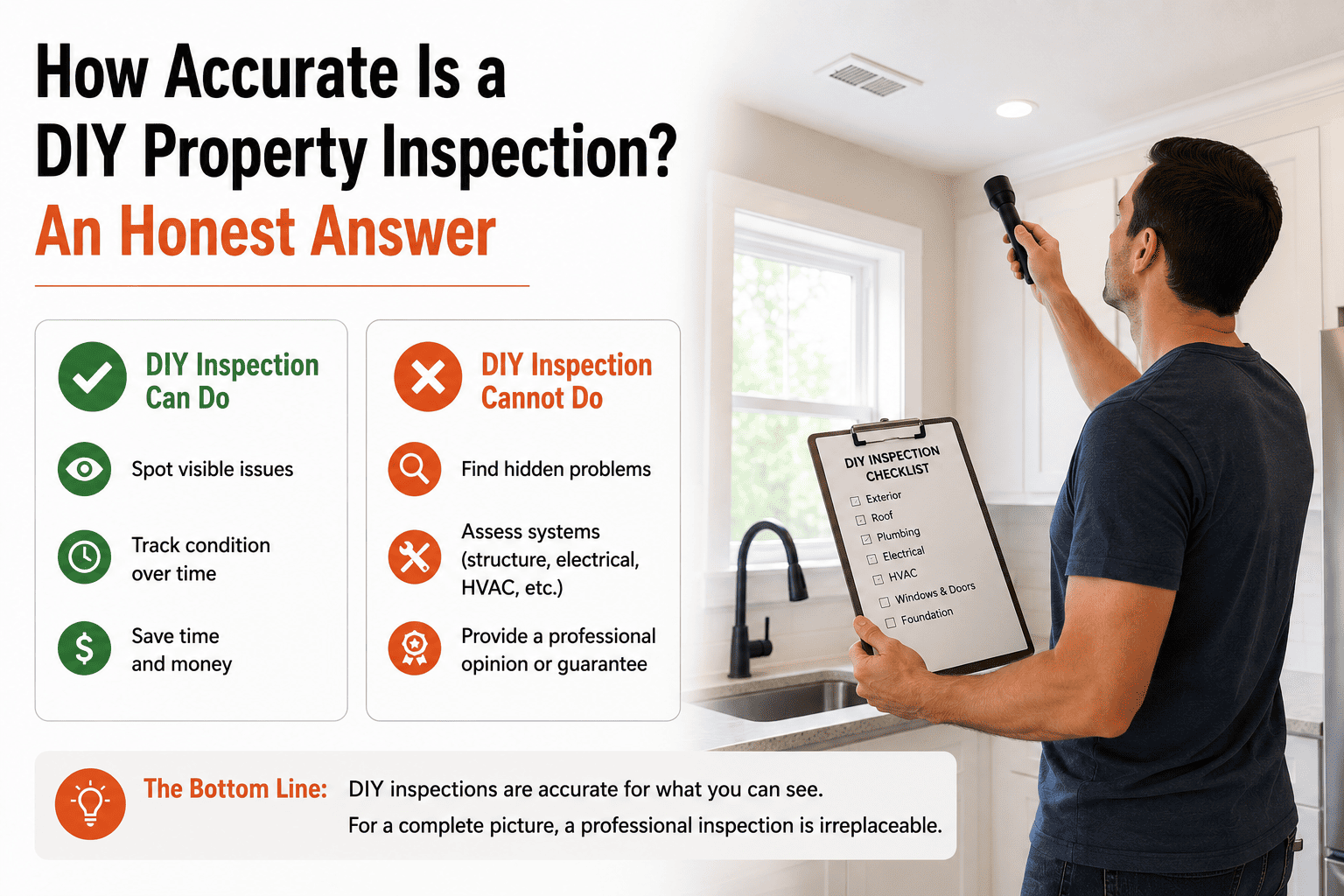
How Accurate Is a DIY Inspection? An Honest Answer.
A guided checklist reliably finds most visible issues. Here is exactly what it catches, what it misses, and where you still need a specialist.
What a Guided Self-Inspection Reliably Finds
A self-inspection excels at documenting visible, surface-level conditions — the category that covers the vast majority of routine property documentation needs. With a guided checklist prompting each item, accuracy is high because the checklist eliminates the biggest source of error: forgetting to check something.
Surface damage
Scratches, dents, stains, holes, cracks, chips, and scuffs on walls, flooring, countertops, and fixtures. The most common findings in move-in/move-out documentation.
Fixture function
Faucets drip or do not. Toilets flush or do not. Outlets work or do not. Doors close or do not. Binary observations anyone can make — no training required.
Safety devices
Smoke detectors present and functional. CO detectors present. GFCI outlets trip when tested. Fire extinguisher present and dated. Clear pass/fail items.
Visible water damage
Ceiling stains, under-sink moisture, toilet base staining, window condensation, and efflorescence on foundation walls. You can see it — and photograph it.
Maintenance conditions
HVAC filter condition, caulk deterioration, gutter clogs, peeling paint, grading slope, and weatherstripping gaps. Routine items that compound when ignored.
Equipment age
Data plate photos on the furnace, AC, and water heater give you manufacture date, model, and capacity. A factual observation — you read the label, not diagnose the system.
What a Self-Inspection Will Not Catch
These are the findings that require training, tools, or the ability to evaluate what is behind a surface. A self-inspection does not pretend to cover these — and your report should not either.
Hidden structural issues
Load-bearing problems, foundation movement below grade, structural beam deterioration inside walls, and settling patterns that require an engineer to evaluate.
Concealed mold or moisture
Mold behind drywall, inside ductwork, or underneath flooring. If you cannot see it, you cannot document it. A musty smell is a clue — confirmation requires testing.
Electrical hazards inside panels
Double-tapped breakers, undersized wiring, improper grounding, and arc-fault concerns inside the panel require a licensed electrician to evaluate safely.
Mechanical system diagnosis
Refrigerant charge, combustion efficiency, heat exchanger cracks, and compressor health require HVAC tools and training. You can note that the system runs — not whether it runs correctly.
Accurate where it matters. Honest where it does not. HomeInspecto guides you through every visible item and prompts "Recommend further evaluation" when something needs a specialist — so your report is thorough and your limitations are clear.
How a Guided Checklist Improves Accuracy
The biggest accuracy problem in any inspection — professional or self-directed — is not misidentifying a finding. It is forgetting to check something entirely. A guided checklist eliminates that gap by prompting every item in every room in the same order every time. You do not decide what to check; the checklist decides. Your job is to look, tap, and photograph. This consistency is why guided self-inspections produce reliable, repeatable results even when the person using them has no inspection experience.
Know What You Catch. Know What You Do Not. Act on Both.
HomeInspecto gives you guided accuracy on every visible condition — and clear referral language for anything that needs a specialist. Honest documentation, every time.
Frequently Asked Questions
How accurate is a self-inspection compared to a professional one?
For visible conditions — surface damage, fixture function, safety devices, and maintenance items — a guided self-inspection catches 85 to 90 percent of what a professional would note. For hidden defects — structural issues behind walls, concealed mold, electrical hazards inside panels, and mechanical system diagnosis — a self-inspection catches very little. The accuracy gap is not in what you look at — it is in what you cannot see without tools and training.
What makes a guided checklist more accurate than an unguided walkthrough?
Consistency. An unguided walkthrough relies on your memory to decide what to check — and memory is unreliable, especially by the tenth room. A guided checklist prompts every item in every room in the same order every time, eliminating the most common source of missed findings: simply forgetting to look.
When should I stop self-inspecting and call a professional?
When you see signs of a problem you cannot evaluate — active water intrusion with no visible source, foundation cracks wider than a quarter inch, unusual sounds from mechanical systems, or any suspected safety hazard. Use your self-inspection to document what you see and recommend professional evaluation for what you cannot diagnose.
Does HomeInspecto help with specialist referrals?
Yes. The pre-written findings include "Recommend further evaluation by a qualified professional" language for items that exceed a visual assessment. This keeps your report honest and protects you from overstepping. Book a demo or start a free trial.
Accurate on the Visible. Honest About the Rest.
HomeInspecto gives you guided accuracy on every surface-level condition and clear referral language when something needs a specialist. Thorough documentation, honest limitations. Book a demo or try it free.