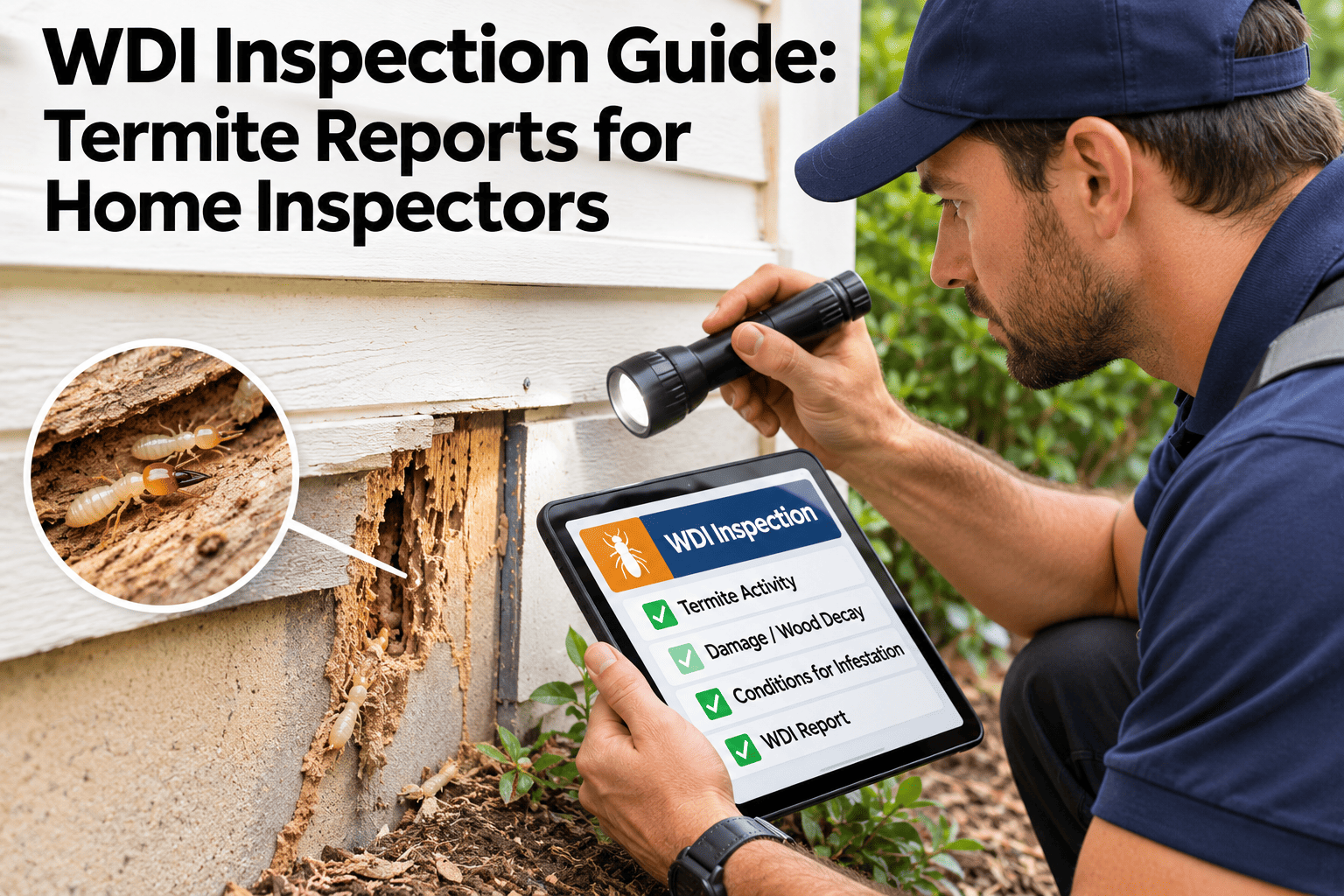
You are days from closing when the lender adds a condition: a wood-destroying insect report on Form NPMA-33. For a home inspector, that is a routine deliverable — a careful visual look at the accessible parts of a home, every finding photographed, written up on the form lenders and buyers accept. This guide covers what the inspection looks for, the insects behind the damage, and how to document each finding so the report holds up. Run your WDI reports in HomeInspecto.
Form NPMA-33 · Wood Destroying Insect Inspection Report
Specialty inspection guide
The WDI inspection and the termite letter that clears a sale
Mud tubes, frass, hollow wood — the signs are small and easy to miss. Here is what a WDI inspection checks, the pests behind each sign, and how to record every finding on the NPMA-33.
Known at closing as the "termite letter"
What a WDI inspection actually is
A wood-destroying insect inspection is a careful visual review of the readily accessible areas of a home for evidence of termites and other wood-destroying insects — and the conditions that invite them. It is reported on the NPMA-33, the standardized form published by the National Pest Management Association, often called the termite letter or clearance letter.
Lenders drive the timing. For HUD and VA-backed loans in moderate-to-heavy termite zones — most of the country — the WDI report on Form NPMA-33 is required, and it is widely used for conventional sales too. One point to set with every client: the report states what was visible on the inspection date. It is not a warranty that the home is insect-free, and framing it that way upfront prevents a dispute later — see how HomeInspecto frames the report in a demo.
Know your wood-destroying insects
The sign you find points to a specific pest, and each one behaves differently. Scroll the comparison sideways on a phone.
- Subterranean termites Drywood termites Carpenter ants
- How they live Nest in soil, need constant moisture, travel up to reach wood. Live entirely inside dry wood, with no soil contact needed. Nest in moist or damaged wood — they tunnel it, they don't eat it.
- Tell-tale sign Mud tubes running from soil up to the wood. Tiny ridged fecal pellets kicked out of the wood. Coarse sawdust-like shavings plus winged swarmers.
- Where to look Foundation walls, piers, crawl space, slab penetrations. Attic rafters, fascia, eaves — common in southern and coastal areas. Around moisture: window frames, rooflines, decks.
- Damage pace The most destructive over time. Slower and localized to the infested member. Structural where moisture is left unaddressed.
Reinfesting wood-boring beetles, such as powderpost beetles, are the fourth group the form covers — their fine frass and small exit holes round out the list. Capture each finding by pest type in HomeInspecto.
The signs inspectors look for
Most WDI findings come down to five visual cues. Each one tells you what you are dealing with.
- Mud tubesPencil-width earthen tubes on foundations, piers, or pipes — direct evidence of subterranean termites bridging soil to wood.
- Frass & pelletsSmall sawdust-like piles or ridged pellets at the base of framing — the calling card of drywood termites and wood-boring beetles.
- Discarded wingsPiles of shed wings on sills or in webs mean a swarm came through — a sign of an active or recent colony nearby.
- Hollow or blistered woodWood that sounds papery when tapped, or paint that bubbles, often hides tunneling just beneath the surface.
- Exit holesSmall round holes in wood surfaces point to drywood termites or beetles emerging from inside.
A probe and a flashlight confirm what the eye flags. See the signs-to-findings flow in a demo.
Every finding, photographed and placed
Log the sign, tag the pest, mark the location, and attach the photo — the NPMA-33 fills itself from the field record.
Conducive conditions — the invitations
The form records more than active infestation. It flags the conditions that make a home attractive to termites, even when none are present yet. These do not require treatment, but they warrant correction.
- 1Wood-to-soil contact — siding, posts, or steps touching the dirt give termites a hidden path in.
- 2Excess moisture — a damp crawl space, wood at 20% moisture or higher, or an unaddressed leak.
- 3Cellulose debris under or against the structure — scrap wood, stumps, or buried form boards.
- 4Mulch or firewood piled against the foundation line.
- 5Poor grading or drainage toward the house, and leaking hose bibs that keep the soil wet.
- 6Wood-decay fungi, which signal the chronic moisture termites favor.
Noting these is what separates a thorough report from a box-ticking one. Track conducive conditions on every WDI in HomeInspecto.
What the NPMA-33 records
The form has a fixed shape, and every section needs a clear answer backed by what you saw.
- FindingsVisible evidence of active or previous infestation, and any wood-destroying insect damage noted.
- Conducive conditionsThe moisture, contact, and debris issues that could invite future activity.
- ObstructionsAreas that were inaccessible or not inspected, stated plainly so nothing is implied clear.
- RecommendationsWhether treatment or correction is advised, and the reason behind it.
- CertificationInspector and company details, license number, and signatures.
The 2019 revision tightened the language — "defects" became "wood destroying insect damage" — so precise wording matters more than ever. See the NPMA-33 layout in a demo.
How HomeInspecto keeps the WDI clean
-
Pest-tagged findings
Mark each sign as subterranean, drywood, carpenter ant, or beetle, so the report reads consistently.
-
Location on every note
Pin each finding to a room or structural area, so nothing floats without a place.
-
Photo with each finding
Attach a mud-tube or frass shot to its note, building the visual record the form expects.
-
Conducive-condition prompts
Built-in reminders for moisture, wood-soil contact, and debris, so none get skipped.
-
Obstruction logging
Record what you could not reach, keeping the report honest about scope.
-
Report on file per property
Every WDI, photo, and recommendation stays searchable for the next sale or refinance.
A faster write-up, a cleaner form, and a record you can stand behind. Book a demo on your own WDI flow.
Frequently asked questions
What is a WDI inspection?
A visual inspection of the accessible areas of a home for evidence of wood-destroying insects — termites, carpenter ants, and wood-boring beetles — plus the conditions that invite them. It is reported on Form NPMA-33. See the flow in a quick demo.
What is the NPMA-33 form?
The standardized Wood Destroying Insect Inspection Report published by the National Pest Management Association, commonly called the termite letter. It is required for HUD and VA-backed loans in termite-prone zones and widely used for conventional sales.
What are the signs of termites?
Mud tubes on the foundation point to subterranean termites; small ridged pellets or frass point to drywood termites or beetles; discarded wings signal a swarm; and hollow-sounding or blistered wood hides tunneling. A photographed finding is what makes the call defensible — start a free trial.
Does a clear WDI report guarantee no termites?
No. The report states what was visible on the inspection date. It is not a warranty that the home is insect-free, which is why obstructions and inaccessible areas are recorded honestly.
What are conducive conditions?
Conditions that invite future activity — wood-to-soil contact, excess moisture, debris, mulch against the foundation, and poor drainage. They don't require treatment, but noting them makes the report thorough. See how they're tracked in a demo.
Sign the letter with confidence
Document every WDI finding and deliver the NPMA-33 faster
Pest-tagged findings, photos on every note, and conducive-condition prompts — a report that clears the sale and holds up after it.