
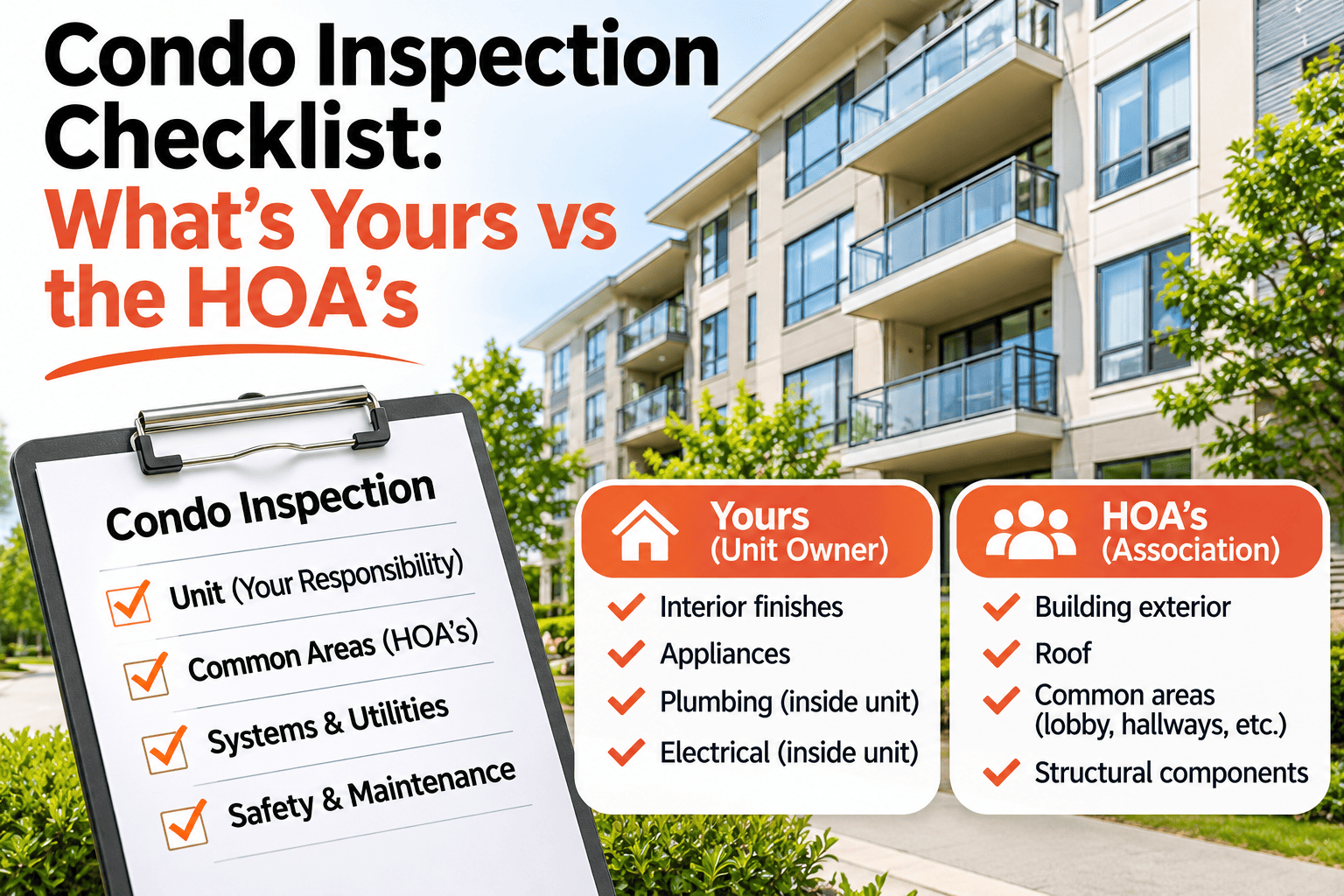
Buying a condo raises one question a house never does: where does your responsibility end and the association's begin? That line decides what an inspection should cover — and a clean report on your unit says nothing about the roof, the elevators, or the reserve fund that pays for them. This checklist covers what the inspector checks inside your walls, what belongs to the HOA, and the reserve study that tells the building's real story. Run condo inspections in HomeInspecto.
Specialty inspection guide
Condo inspection checklist: what's yours vs the HOA's
The inspection follows the ownership line. Here is where it falls, what sits on each side, and the document that reveals the building behind your unit.
- Inside your unitYours to inspect and maintain
- vs
- Building & commonThe HOA's responsibility
The line that defines the inspection
In most associations you own and maintain everything from the interior surface of your walls inward, while the HOA handles the exterior and the common areas. The association's declaration draws the exact line, and it is what the inspection scope should follow.
The risk is assuming the HOA covers everything. A buyer who reads a clean unit report and pictures a sound building may be misreading what was actually examined — the inspector looked inside the unit, not at the roof or the finances behind it. Matching the inspection to the ownership structure is what keeps that gap from becoming a surprise. See how scope is set in a demo.
What the inspector covers inside
Inside the unit, a condo inspection goes to single-family depth on the systems you'll own.
Plumbing
Fixtures and visible supply and drain lines within the unit.
Electrical
Outlets, switches, and the unit panel if there is one.
HVAC
The unit's heating and cooling equipment and its condition.
Water heater
Where the unit has its own, checked for age and safety.
Windows & doors
Operation, seals, and signs of leaks around them.
Interior & appliances
Walls, ceilings, floors, and the appliances that stay.
Everything a buyer will own and be responsible for, examined at full depth. Capture each system in HomeInspecto.
What belongs to the HOA
Beyond the unit walls, the association generally owns and maintains the shared structure and spaces. The inspector notes what's visible but doesn't assess maintenance the owner isn't responsible for.
- The building exterior, roof, and structure
- Hallways, stairwells, lobbies, and elevators
- Shared amenities — pools, gyms, and parking structures
- Exterior walls and the systems serving the whole building
If the owner doesn't maintain it, the inspector typically notes it from the ground and disclaims it. See the scope boundaries in a demo.
Limited common elements — the gray zone
Some parts sit between the two: the HOA may own them while you have exclusive use, and the declaration decides who pays when they fail.
- Balconies & patiosYours to use, often the HOA's to maintain
- Assigned parkingExclusive use, shared ownership
- Shared wallsThe boundary between units and responsibility
Ask the inspector to note condition, then let the declaration tell you who pays. Flag limited-common items in HomeInspecto.
Inspect the unit, flag the building
Full-depth on what's yours, clear notes on what's shared, and a report that tells a buyer exactly which side of the line each finding falls on.
The reserve study tells the building's story
A unit can look pristine while the building's finances foreshadow a five-figure surprise. The reserve study is where that shows up — and it's the document a condo buyer most needs to read.
- What it isAn estimate of when major shared components — roof, elevators, siding, boilers, paving — will need replacement, and what each will cost.
- Why it mattersUnderfunded reserves lead to special assessments that land on owners. A common rule of thumb: a fund near 70% of what the study recommends is reasonably healthy.
- Read it togetherA ceiling stain in the report means more if board minutes show repeated roof leaks and the study shows the roof near end of life.
The inspection tells you about the unit; the reserve study tells you about the building. See how findings pair with HOA docs in a demo.
Documents to request
Pair the inspection with the paperwork that reveals the building's condition and finances.
- The most recent reserve study
- The association budget and insurance summary
- Board meeting minutes from the last 12 to 24 months
- Any litigation history
- Notices of special assessments, planned or recent
Together with the inspection report, these show the unit and the building, side by side. Keep the inspection record in HomeInspecto.
How HomeInspecto handles condos
Unit-scoped template
Built around the interior systems you'll own, at single-family depth.
Yours-vs-HOA tagging
Mark each finding as unit, limited-common, or HOA, so the line is clear.
Disclaim shared systems
Note building components from the ground and flag them as out of scope.
Photo on every finding
Each note carries its image, inside the unit and at the boundary.
Buyer-ready export
A clean report a buyer can read alongside the HOA documents.
Record per unit
Every inspection stays on file for the next sale.
The ownership line, built into the report. Book a demo on your own workflow.
Frequently asked questions
Do you need a condo inspection?
Yes. The HOA covers the exterior and common areas, but everything inside your walls is yours — plumbing, electrical, HVAC, windows, and appliances all warrant an inspection. See the scope in a quick demo.
What does a condo inspection cover?
The unit's interior systems at full depth — plumbing, electrical, HVAC, water heater, windows, interior surfaces, and appliances — plus notes on shared components and guidance on where the HOA boundary falls.
What's the HOA responsible for versus me?
Generally, you own everything inside your walls and the HOA maintains the exterior, structure, and common areas. The association's declaration draws the exact line — start a free trial to document your side.
Why does the reserve study matter?
It shows when major shared components will need replacement and whether the association has saved for it. Underfunded reserves become special assessments, so a pristine unit in a cash-poor building is still a risk.
How much does a condo inspection cost?
Often from around $275 for a smaller unit, into the $450 to $1,000 range in higher-cost markets. It's narrower than a whole-house inspection because the shared building is the HOA's domain. See what's included in a demo.
Your side of the line, documented
Inspect the unit, and show the buyer the boundary
A unit-scoped template, yours-vs-HOA tagging, disclaimed shared systems, and a photo on every finding — the ownership line, built in.