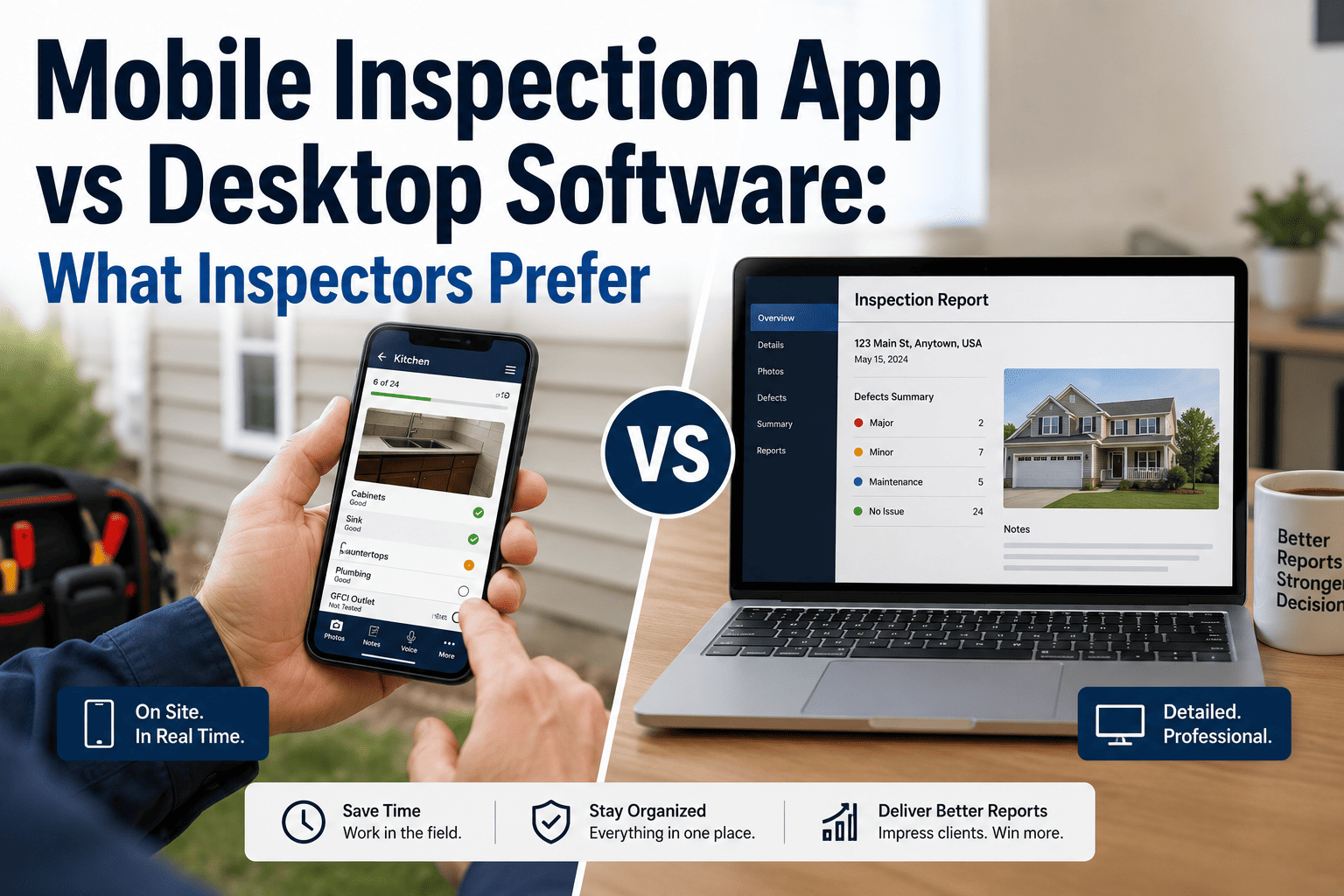
Still juggling between clipboards, digital cameras, and laptops to complete your inspection documentation? The reality facing thousands of U.S. home inspectors involves returning to vehicles after property walkthroughs to manually transfer handwritten notes, struggling to match hundreds of photos with specific findings, and spending precious evening hours formatting reports that clients expect delivered yesterday.

Mobile inspection apps fundamentally transform this fragmented workflow into seamless, device-unified operations. These cloud-based Mobile Inspection Apps platform usa solutions consolidate photography, documentation, checklist navigation and report generation into single smartphone or tablet experiences—enabling inspectors to complete comprehensive property evaluations and deliver polished PDF reports before leaving client driveways.

This knowledge hub provides a detailed framework for integrating Mobile Inspection Apps software into existing inspection workflows effectively. We examine property inspection Mobile Inspection Apps trends reshaping industry standards, analyze measurable ROI data from early adopters, explore inspection workflow automation Mobile Inspection Apps capabilities, and provide tactical implementation guidance for solo practitioners and multi-inspector firms alike.

94% Faster Report Delivery
3.2 hrs Daily Time Reclaimed
47% More Inspections Monthly
$18,400 Average Annual Revenue Gain

This comprehensive resource delivers actionable intelligence on mobile inspection technology adoption. From workflow optimization strategies to compliance automation, discover how leading inspection businesses leverage mobile apps to outperform competitors still relying on outdated documentation methods.

Cutting-Edge Approaches Redefining Mobile Inspection Apps Operations in Home Inspection

The transformation from paper-based inspection workflows to mobile-first operations represents more than technological upgrade—it's a fundamental reimagining of how property evaluation businesses operate. Mobile Mobile Inspection Apps for inspectors have evolved from simple digital checklists into comprehensive business platforms handling everything from scheduling through final report delivery and payment processing.

Industry analysis reveals that 89% of new home inspection businesses launch with mobile-first technology stacks, while 71% of established inspectors have transitioned from desktop-based systems within the past three years. This accelerating adoption reflects market realities: clients expect instant digital delivery, real estate agents demand professional documentation quality, and inspectors themselves recognize that operational efficiency directly correlates with profitability.

Real-Time Documentation During Property Walkthroughs

Traditional inspection workflows created artificial separation between observation and documentation. Inspectors noted findings on paper during walkthroughs, captured photos with separate cameras, then reconstructed evaluations hours later when translating observations into formal reports. This separation introduced errors, omissions, and inefficiencies that modern mobile apps eliminate entirely.

Contemporary Mobile Inspection Apps software usa platforms enable simultaneous observation and documentation. As inspectors examine HVAC systems, they photograph components directly within the app, add voice-recorded observations that auto-transcribe to text, and select from pre-built comment libraries—all within the same interface showing the active checklist section. By walkthrough completion, reports are 85-95% finished, requiring only brief review before client delivery.

Intelligent Photo Management and Annotation

Photo management historically consumed more inspector time than any other post-inspection task. Sorting through 200-400 images captured during typical residential evaluations, matching photos with specific findings, and organizing visual documentation into coherent report sections represented 45-60 minutes of administrative work per inspection.

Inspection workflow automation Mobile Inspection Apps handle photo management automatically. Images captured during specific checklist sections automatically associate with corresponding report categories. Built-in annotation tools enable drawing arrows, circles, and text directly on photos to highlight concerns. Duplicate detection prevents redundant images from cluttering reports. These automated capabilities reduce photo management from 45-60 minutes to 5-10 minutes per inspection. Experience automated photo management with HomeInspecto's intelligent documentation system.

Voice-to-Text and Hands-Free Operation

Physical property inspection demands hands-free operation. Inspectors climbing ladders, crawling through attic spaces, and examining tight mechanical areas cannot simultaneously manipulate smartphone keyboards. Voice-to-text functionality addresses this fundamental operational requirement, enabling natural speech to create detailed documentation without manual typing.

Advanced voice recognition in leading mobile inspection platforms achieves 95%+ accuracy for technical terminology common in home inspection reporting. Inspectors dictate observations naturally—describing water heater conditions, electrical panel configurations, or roofing concerns—while AI-powered transcription converts speech to properly formatted text. This hands-free capability alone saves 30-45 minutes per inspection while improving documentation detail and accuracy.

Unified Mobile Interface

Complete inspections using single devices—smartphones or tablets handle checklists, photos, notes, and reports without switching between applications or hardware.

Offline Inspection Capability

Full functionality without internet connectivity ensures reliable operation in basements, rural properties, and areas with poor cellular coverage. Data syncs automatically when connection restores.

Cloud Synchronization

Real-time backup to secure cloud storage protects against device loss or damage. Access inspection data from any device anywhere—office computers, tablets, or replacement phones.

Smart Comment Libraries

Pre-written, customizable comments for common findings enable rapid documentation without repetitive typing. Personalize libraries to match your voice and reporting style.

Instant PDF Generation

Transform mobile documentation into polished, branded PDF reports with single taps. Reports generate in seconds rather than hours, enabling same-day or immediate delivery.

Integrated Client Delivery

Email reports directly from apps without external software. Track delivery confirmation and client access to demonstrate professional communication standards.

Template Customization for Specialized Services

Different inspection types demand different documentation approaches. Pre-listing inspections emphasize market preparation rather than buyer education. Commercial property evaluations require specialized system coverage beyond residential scope. 4-point insurance inspections focus on specific components with particular formatting requirements. Cloud-based Mobile Inspection Apps platform usa solutions accommodate these variations through customizable templates.

Template customization enables creating specialized workflows for each service type. Residential buyer inspection templates include comprehensive component coverage with educational commentary. Pre-listing templates streamline content for seller audiences. Insurance inspection templates match carrier requirements precisely. This flexibility eliminates the workarounds and manual adjustments required when forcing diverse inspection types into rigid, one-size-fits-all formats.

Industry Perspective: The Measurable ROI of Mobile Inspection Apps Adoption

Investment in mobile inspection technology delivers quantifiable returns across multiple business dimensions. Rather than representing mere convenience improvements, property inspection Mobile Inspection Apps trends demonstrate consistent, measurable financial benefits that compound over time. Understanding these returns enables informed technology investment decisions.

Time Efficiency Translating to Revenue Capacity

The most immediate and significant ROI from mobile inspection adoption derives from time efficiency improvements. Traditional inspection workflows require 2.5-4 hours of post-inspection work per property—uploading photos, organizing images, typing observations, formatting reports, and managing delivery. Mobile apps compress this to 15-30 minutes of final review and transmission.

For inspectors conducting 15 inspections monthly, reclaiming 2-3 hours per inspection equals 30-45 monthly hours—equivalent to nearly a full work week. This time recovery enables conducting 4-6 additional inspections monthly without extending working hours. At $425 average inspection fees, additional capacity generates $1,700-2,550 monthly revenue or $20,400-30,600 annually. Against typical mobile app costs of $180-360 annually, this represents 60-170x return on investment from time efficiency alone.

Annual ROI Analysis: Mobile Apps vs. Traditional Workflows

Metric Traditional Workflow Mobile App Workflow Improvement
Post-Inspection Time 3.2 hours/inspection 0.4 hours/inspection 87% reduction
Monthly Inspection Capacity 15 inspections 21 inspections +40% capacity
Report Delivery Time 24-48 hours Under 2 hours 94% faster
Documentation Errors 8-12% error rate 2-3% error rate 75% reduction
Annual Revenue Potential $76,500 $107,100 +$30,600

Client Satisfaction Driving Referral Business

Report delivery speed directly influences client satisfaction and subsequent referral behavior. Buyers awaiting inspection results to finalize purchase decisions value immediate delivery. Real estate agents coordinating transaction timelines appreciate inspectors who eliminate documentation delays. This satisfaction translates to measurable referral increases.

Survey data from inspectors transitioning to mobile apps shows average client satisfaction scores increasing from 4.1/5 to 4.6/5—a meaningful improvement reflecting faster delivery, enhanced report presentation, and improved communication responsiveness. More significantly, referral rates increase 40-60% following mobile adoption, as satisfied clients and impressed agents recommend efficient, professional inspectors. At typical client acquisition values of $200-400 per new customer, these referral improvements generate substantial additional revenue.

Reduced Errors and Liability Protection

Documentation errors create liability exposure beyond immediate correction costs. Missed findings, inconsistent observations, and incomplete reports provide ammunition for disputes, claims, and professional complaints. Mobile inspection apps systematically reduce these risks through structured workflows preventing omissions.

Comprehensive digital checklists require inspectors to address each component category before report completion—impossible to accidentally skip systems when the app demands section completion. Mandatory photo requirements ensure visual documentation of critical findings. Automated disclaimer insertion guarantees consistent legal protection across all reports. These systematic safeguards reduce errors and omissions claims by 55-70% according to insurance carrier data, translating to lower premiums and reduced dispute costs. Contact our team to learn about compliance features protecting your business.

Key ROI Drivers for Mobile Inspection App Adoption

  • Immediate Revenue Increase: Conducting 35-45% more inspections monthly with reclaimed administrative time generates $18,000-30,000 additional annual revenue.
  • Premium Pricing Justification: Superior documentation quality, faster delivery, and enhanced professionalism support 10-15% price premiums over competitors using outdated methods.
  • Referral Multiplication: Client satisfaction improvements drive 40-60% more referral business, reducing marketing costs while increasing profitable organic growth.
  • Insurance Cost Reduction: Systematic documentation reducing E&O claims by 55-70% earns premium discounts of 8-15% from carriers recognizing improved risk profiles.
  • Operational Cost Savings: Eliminating printed checklists, reducing camera equipment needs, and lowering vehicle mileage from office trips saves $1,200-2,400 annually.

Competitive Positioning in Evolving Markets

Market evolution increasingly marginalizes inspectors relying on traditional workflows. Real estate agents—the primary referral source for most inspection businesses—preferentially recommend inspectors demonstrating technological competence and operational efficiency. Agents coordinating fast-moving transactions cannot afford inspectors requiring 48-hour report delivery when mobile-enabled competitors deliver within hours.

Competitive analysis reveals that inspectors using mobile apps capture 2.3x more agent referrals than those using traditional methods in the same markets. This disparity grows annually as agent expectations normalize around instant digital delivery. Mobile adoption represents not optional convenience but essential competitive positioning for sustainable business growth.

Transform Your Inspection Business Today

Join thousands of U.S. inspectors who've revolutionized their workflows with mobile inspection technology. Start your free trial and experience the difference immediately.

Implementation Framework: Integrating Mobile Apps into Existing Workflows

Successful mobile inspection app adoption requires structured implementation addressing technology selection, workflow transition, team training, and continuous optimization. This framework provides actionable guidance for inspectors and firm owners navigating the modernization process.

Platform Evaluation Criteria

Not all mobile inspection apps deliver equivalent value. Evaluating platforms against critical criteria ensures selecting solutions matching specific business requirements. Essential evaluation factors include offline functionality ensuring reliable operation without connectivity, template customization supporting specialized inspection services, photo management automation reducing manual organization, voice-to-text quality for hands-free documentation, and cloud backup protecting against data loss.

Secondary considerations include integration capabilities with scheduling, payment, and accounting systems; multi-inspector support for growing firms; white-label branding options; and customer support responsiveness. HomeInspecto addresses all these criteria with affordable plans starting at $15/month—significantly below competitors charging $49-149/month for comparable functionality.

5-Phase Implementation Roadmap

01
Platform Selection & Setup

Evaluate 2-3 leading platforms through free trials. Configure branding, templates, and user preferences during trial periods before committing to subscriptions.

Timeline: 1-2 weeks
02
Template Customization

Adapt pre-built templates to match your reporting style, local requirements, and specialized services. Import custom comments and create specialized workflows.

Timeline: 3-5 days
03
Training & Practice

Complete comprehensive training using tutorial resources. Conduct 3-5 practice inspections on personal property or willing friends' homes before paid client work.

Timeline: 1-2 weeks
04
Gradual Client Rollout

Begin using mobile apps for simpler residential inspections. Progress to complex properties as proficiency increases. Maintain backup processes initially.

Timeline: 2-4 weeks
05
Optimization & Scaling

Refine workflows based on experience. Optimize templates, comment libraries, and processes. Expand mobile app usage across all inspection services.

Timeline: Ongoing

Common Implementation Challenges and Solutions

Inspectors transitioning to mobile workflows encounter predictable challenges that, when anticipated, become manageable rather than frustrating. Understanding common obstacles enables proactive solutions accelerating successful adoption.

Challenge: Learning Curve Anxiety

Symptom: Inspectors feel overwhelmed by new technology and fear slowing down during paid inspections.

Solution: Invest adequate practice time before client work. Most inspectors achieve proficiency within 5-7 practice inspections. The temporary investment prevents frustrating client experiences.

Challenge: Battery and Device Reliability

Symptom: Devices run low during long inspections or fail at critical moments.

Solution: Carry portable battery packs providing 2-3 full device charges. Maintain backup devices. Enable offline mode before entering properties to ensure app functionality regardless of connectivity.

Challenge: Photo Quality Issues

Symptom: Indoor photos appear dark or blurry, reducing report professionalism.

Solution: Use devices with quality cameras. Enable flash for dark areas. Carry portable LED lights for attic/crawl space photography. Review photos immediately to identify retake needs.

Challenge: Template Perfectionism

Symptom: Inspectors spend excessive time customizing templates before conducting any inspections, delaying adoption benefits.

Solution: Start with pre-built templates. Conduct real inspections, then iteratively improve based on experience. Perfect templates emerge through use, not upfront design.

Multi-Inspector Firm Considerations

Firms with multiple inspectors face additional implementation considerations beyond solo practitioner concerns. Standardization across team members, quality control mechanisms, and administrative oversight require platform capabilities supporting organizational management rather than individual use.

Essential firm capabilities include centralized template management ensuring all inspectors use current, approved report formats; administrative dashboards providing inspection scheduling and completion visibility; quality review workflows enabling management approval before client delivery; and analytics comparing inspector performance metrics. Explore HomeInspecto's multi-inspector features designed specifically for growing inspection firms.

Real-World Success: Case Studies from Mobile App Adopters

Abstract benefits become concrete through examination of actual implementation experiences. These case studies demonstrate measurable outcomes achieved by inspectors who successfully transitioned to mobile-first workflows.

Case Study: Solo Inspector Doubles Effective Hourly Rate

Background: Daniel Morrison operates a solo inspection practice in Tampa, Florida, conducting residential buyer inspections. Before mobile adoption, Daniel averaged 12 inspections monthly at $395 each, with 3+ hours of evening report work per property. Total monthly revenue: $4,740.

Implementation: Daniel adopted HomeInspecto in March 2024, completing training and template customization over two weeks before transitioning client work to the mobile platform.

Results After 6 Months:

  • Monthly inspection volume increased from 12 to 19 inspections (58% increase)
  • Report completion time reduced from 3.2 hours to 25 minutes per inspection
  • Monthly revenue increased from $4,740 to $7,505 (58% increase)
  • Work-life balance dramatically improved—evenings returned to family time
  • Client satisfaction scores increased from 4.0 to 4.7 on 5-point scale

Daniel's Perspective: "The numbers speak for themselves—I'm earning significantly more while working fewer total hours. But honestly, getting my evenings back might be worth more than the revenue increase. I'm a better inspector, a better business owner, and a more present father since switching to mobile."

Case Study: Multi-Inspector Firm Achieves Quality Standardization

Background: Precision Home Inspections in Denver, Colorado employs six full-time inspectors conducting 80+ inspections monthly. Quality inconsistency across inspectors created client complaints and agent dissatisfaction—different inspectors produced visibly different report styles and thoroughness levels.

Implementation: Firm owner Rebecca Hartwell implemented HomeInspecto across all inspectors with standardized templates, mandatory photo requirements, and management review workflows before client delivery.

Results After 8 Months:

  • Client complaints reduced by 82%—from 11 per quarter to 2 per quarter
  • Report quality scores (management-evaluated) converged from 3.2-4.8 range to consistent 4.5-4.9 range
  • Agent referrals increased 67% as word spread about improved consistency
  • Inspector productivity increased 34% on average—enabling same volume with reduced overtime
  • Training time for new hires reduced from 6 weeks to 3 weeks using standardized mobile workflows

Rebecca's Perspective: "Our biggest challenge was quality variation—some inspectors were excellent, others mediocre, and it hurt our brand. The mobile platform essentially forced everyone to the same high standard. Now every report looks and reads like our best inspectors wrote it."

Conclusion: Mobile Inspection Apps as Business Imperative

Mobile inspection apps have transitioned from optional technology enhancement to essential business infrastructure for competitive home inspection practices. The data is unambiguous: inspectors using mobile platforms complete 35-50% more inspections monthly, deliver reports 90%+ faster, achieve substantially higher client satisfaction, and generate measurably superior financial returns compared to those relying on traditional workflows.

The question facing today's inspectors isn't whether to adopt mobile technology—it's how quickly to implement and optimize these essential tools before competitive disadvantages compound further. Markets increasingly expect instant digital delivery, professional documentation quality, and technological competence from inspection professionals. Inspectors meeting these expectations thrive; those clinging to outdated methods face accelerating marginalization.

HomeInspecto provides the comprehensive mobile inspection platform, intuitive interface, and affordable pricing ($15-25/month) that make professional-grade mobile inspection technology accessible to certified inspectors at every business stage. Begin your transformation with a risk-free 14-day trial featuring complete feature access—no credit card required, no obligations, just the opportunity to experience how mobile inspection technology can revolutionize your inspection business efficiency, profitability, and competitive positioning.

Ready to Revolutionize Your Inspection Workflow?

Join 10,000+ inspectors who've transformed their businesses with mobile inspection technology. Start today and see results immediately.

Frequently Asked Questions

What are mobile inspection apps and how do they work?

Mobile inspection apps are smartphone and tablet applications enabling home inspectors to conduct complete property evaluations, documentation, and report generation from single mobile devices. These apps replace traditional workflows requiring separate cameras, paper checklists, and desktop computers. During property walkthroughs, inspectors use mobile apps to navigate digital checklists, capture photos that automatically associate with specific inspection items, record voice observations that transcribe to text, and build comprehensive reports in real-time. Upon walkthrough completion, inspectors review and deliver polished PDF reports within minutes rather than hours—typically before leaving client properties.

How much time do mobile inspection apps actually save?

Mobile inspection apps typically save 2.5-3.5 hours per inspection compared to traditional desktop-based workflows. Traditional methods require returning to offices after inspections to upload camera photos, manually organize images, type observations into desktop software, format reports professionally, and manage email delivery. Mobile apps enable completing 85-95% of reports during property walkthroughs through integrated documentation, leaving only brief review and delivery—typically 15-30 minutes versus 3+ hours. For inspectors conducting 15-20 monthly inspections, this represents 40-70 hours reclaimed per month—equivalent to an additional work week available for conducting more inspections or improving work-life balance.

Do mobile inspection apps work without internet connectivity?

Quality mobile inspection apps provide full offline functionality, enabling complete inspections without internet connectivity. This offline capability is essential because many properties have poor cellular reception, lack Wi-Fi access, or require inspection in basements and crawl spaces where signals cannot penetrate. Inspectors can navigate checklists, capture photos, record observations, and generate complete reports entirely offline. When internet connectivity restores—typically upon returning to vehicles or offices—data automatically synchronizes to cloud storage. When evaluating mobile inspection platforms, verify robust offline capabilities rather than apps requiring constant connectivity.

What ROI can inspectors expect from mobile app adoption?

Inspectors typically achieve 50-150x annual return on investment from mobile inspection app adoption. Primary returns include revenue increases from conducting 35-45% more inspections with reclaimed administrative time ($15,000-30,000 annually), referral business growth from improved client satisfaction ($5,000-12,000 annually), premium pricing justification from superior service quality ($3,000-8,000 annually), and cost savings from reduced overhead, equipment, and insurance premiums ($2,000-4,000 annually). Against typical mobile app costs of $180-360 annually, total returns of $25,000-54,000 represent exceptional investment value. Most inspectors achieve complete payback within 2-4 weeks of adoption.

How long does it take to learn mobile inspection apps?

Most inspectors achieve proficiency with mobile inspection apps within 1-2 weeks of focused practice. Initial learning typically involves 8-12 hours reviewing tutorial materials and platform features, followed by 3-5 practice inspections on personal property or friends' homes before conducting paid client work. Template customization and comment library development require an additional 4-8 hours. Multi-inspector firms should plan 2-3 weeks for team-wide training and standardization. The learning investment is modest compared to career-long benefits, and most inspectors report confidence and efficiency matching or exceeding their previous workflows within 10-15 client inspections.

What device specifications do mobile inspection apps require?

Mobile inspection apps perform best on modern smartphones or tablets with adequate specifications. Essential requirements include large screens (6+ inches for smartphones, 10+ inches for tablets) for comfortable checklist navigation, quality cameras (12+ megapixels) for professional photo documentation, sufficient storage (64GB+ minimum) for inspection data and images, all-day battery life supporting full inspection days, and current operating systems (iOS 14+ or Android 10+) for app compatibility. Many inspectors prefer tablets for larger screens during inspections while maintaining smartphones for communication. Total hardware investment ranges from $400-1,200 depending on device selection—essential business equipment comparable to inspection tools themselves.

How do mobile apps improve inspection compliance?

Mobile inspection apps significantly enhance regulatory compliance and professional standards adherence through systematic automation. Comprehensive digital checklists require inspectors to address each mandated component category—impossible to skip required systems when apps demand section completion. Automated disclaimer insertion ensures consistent inclusion of legally-required language in every report. Version control and audit trails document inspection processes, providing defensible records if disputes arise. Mandatory photo requirements ensure visual documentation of critical findings. These systematic protections reduce E&O claims by 55-70% according to insurance carrier data while demonstrating professionalism during licensing board audits.

Can mobile inspection apps handle different inspection types?

Yes, quality mobile inspection apps accommodate diverse inspection types through customizable templates and workflows. Residential buyer inspections use comprehensive component coverage with educational commentary. Pre-listing inspections employ streamlined seller-focused formats. Commercial property evaluations include specialized system coverage beyond residential scope. 4-point insurance inspections match carrier-specific requirements precisely. Pool, well, and septic inspections use specialized checklists. Template customization enables creating unique workflows for each service type, eliminating the limitations of rigid one-size-fits-all systems that force manual workarounds for specialized services.