For landlords and public housing agencies renting to voucher holders, the inspection rules are changing. NSPIRE — HUD's National Standards for the Physical Inspection of Real Estate — is replacing the old Housing Quality Standards, and every voucher program has to be on it by February 1, 2027. It reorders what matters toward resident health and safety, grades each problem by severity, and ties the repair clock to that grade. This guide covers the areas it inspects, the deficiency tiers, the life-threatening list, and how to prepare. Run NSPIRE-ready checklists in HomeInspecto.
Rental & voucher inspection guide
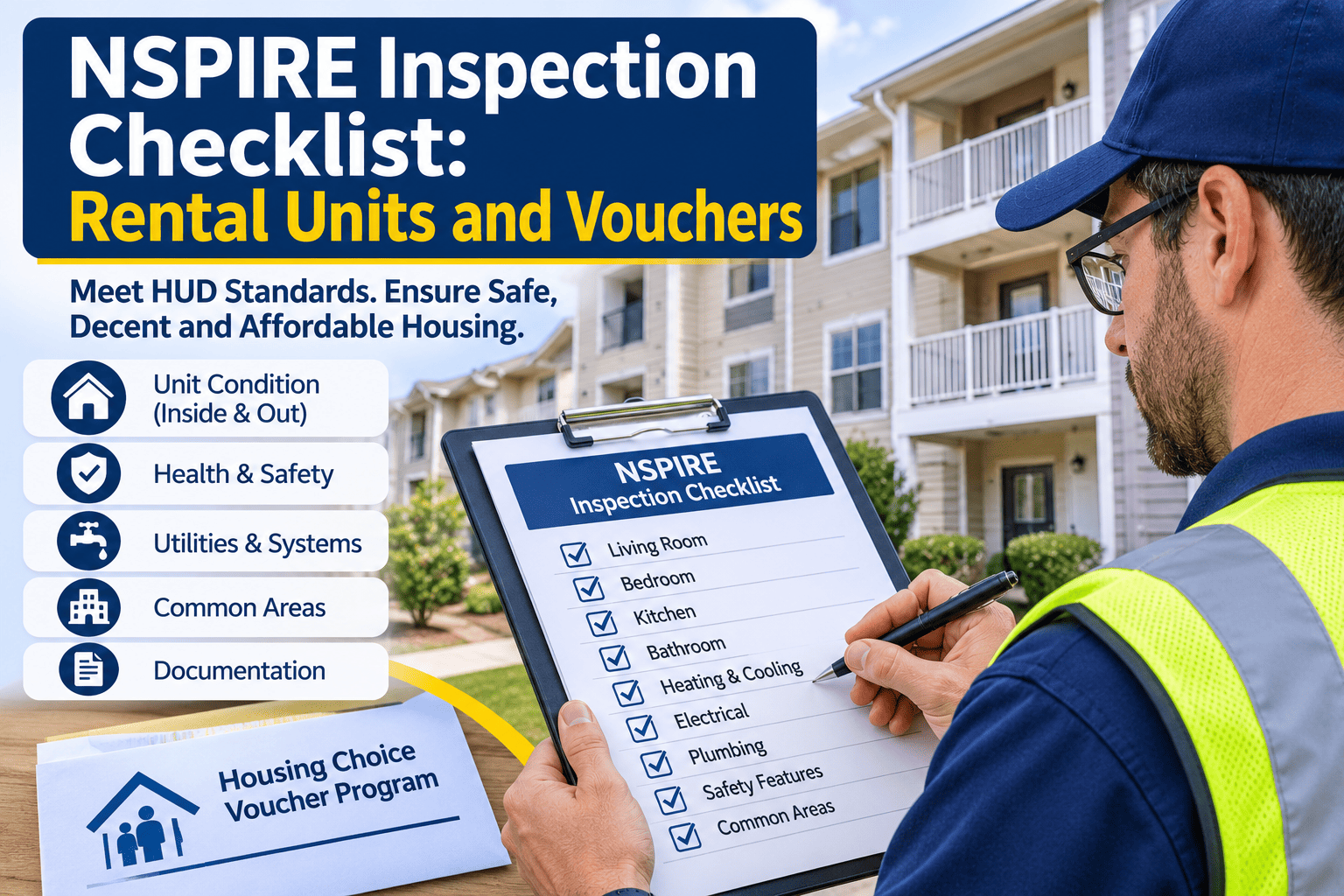
NSPIRE inspection checklist for rental units and vouchers
The standard that retires HQS. Here is what NSPIRE inspects, how severity sets the repair clock, and what the February 2027 voucher deadline means for landlords and PHAs.
- RetiringHQS
- →
- Replacing itNSPIRE
Voucher deadline — February 1, 2027
What NSPIRE is, and what it replaces
NSPIRE is HUD's single physical-inspection standard. It redefines the Housing Quality Standards for the Housing Choice Voucher program and replaces the Uniform Physical Conditions Standards for public housing — one method across HUD housing instead of several.
The shift is bigger than a new form. NSPIRE looks inside the unit first, where residents actually live; it grades deficiencies by severity rather than passing or failing each item one by one; and inspectors use instruments — an outlet tester, a moisture meter, a thermometer — rather than eyeballing. Voucher inspections stay pass or fail overall, but severity decides whether a unit fails and how fast the fix is due. See an NSPIRE checklist in a demo.
The three inspection areas
NSPIRE organizes every standard into three areas, ordered by how close the problem is to the resident.
- 01
Unit
Inside the rented home itself — alarms, electrical, heat, plumbing, and the fixtures a resident uses every day.
- 02
Inside
Common interior spaces of the building — hallways, stairwells, shared systems, and entry areas.
- 03
Outside
The building exterior and grounds — roofing, walls, walkways, and site elements that affect safety.
Putting the unit first is the clearest sign of what NSPIRE cares about: the resident. Build each area into your inspection in HomeInspecto.
Severity sets the repair clock
Every deficiency gets one of four severity grades, and the grade decides whether the unit fails and how long you have to fix it.
- Life-threateningCorrect within 24 hoursFails
- SevereCorrect within 30 daysFails
- ModerateCorrect within 30 daysFails
- LowNo correction clockRecorded, passes
Severe and moderate items share a 30-day window in the voucher program, but a single life-threatening finding fails the unit on a 24-hour clock. See severity tagging in a demo.
The life-threatening list
These are the findings that fail a unit on the spot and start the 24-hour clock. They are the ones worth checking before an inspector arrives.
- A smoke alarm that is missing, damaged, covered, or not working
- A missing or non-functioning carbon monoxide alarm — new under NSPIRE, where HQS had none
- Exposed or otherwise hazardous electrical conditions
- A gas leak or the smell of gas
- A blocked or non-working exit or means of egress
- No working heat during the heating season, October 1 through March 31
Carbon monoxide alarms and heating thresholds are among the biggest changes from HQS, so they are the first place landlords get caught out. Check every life-threatening item with HomeInspecto.
Walk the unit the way NSPIRE will
A checklist built around the three areas and four severity grades, with photos on every deficiency — so nothing fails you on inspection day.
What's different from HQS
If you have passed HQS inspections for years, a few shifts will catch you out under NSPIRE.
- Severity, not a flat list. Deficiencies are graded, and the grade drives both the fail and the repair window.
- Instruments, not just eyes. Inspectors test outlets, measure moisture, and read temperatures.
- Carbon monoxide alarms required. HQS had no CO standard; NSPIRE treats a missing one as life-threatening.
- Mold has thresholds. Surface-area limits now apply where HQS had none.
- Health and safety lead. The whole standard is ordered by risk to the resident.
Some conditions that passed under HQS will not pass now. See the gaps in a demo.
The February 2027 deadline
HUD set February 1, 2027 as the date every Housing Choice Voucher and Project-Based Voucher program must be inspecting under NSPIRE-V, the voucher version of the standard — an extension from the earlier 2025 date.
A transition rule smooths the changeover: a unit stays under the standard in effect when its inspection began until that inspection fully resolves, so a unit started under HQS finishes under HQS. HUD is not providing the inspection software, which leaves landlords and PHAs to find their own tool for running the checklist, capturing photos, and tracking the correction clocks. Start that in HomeInspecto free.
How HomeInspecto gets you NSPIRE-ready
-
Three-area checklist
Unit, Inside, and Outside laid out in NSPIRE order so nothing is missed.
-
Severity on every finding
Tag each deficiency life-threatening, severe, moderate, or low, with the clock attached.
-
Life-threatening alerts
Flag the 24-hour items the moment they're logged, so they're never buried in a report.
-
Photo per deficiency
Every finding carries its evidence, and the proof-of-correction shot after the fix.
-
Correction tracking
Watch the 24-hour and 30-day windows so repairs land inside the deadline.
-
Record per unit
Every inspection and fix stays on file for the next annual visit.
The software HUD isn't giving you, ready before the deadline. Book a demo on your own units.
Frequently asked questions
What is NSPIRE?
HUD's National Standards for the Physical Inspection of Real Estate — one inspection standard across HUD housing that grades deficiencies by severity and location rather than passing or failing each item. See a checklist in a quick demo.
How is NSPIRE different from HQS?
NSPIRE orders inspection by risk to the resident, grades deficiencies by severity with matching correction clocks, uses instruments instead of a purely visual check, and adds requirements HQS lacked, such as carbon monoxide alarms and mold thresholds.
When is the NSPIRE voucher deadline?
Every Housing Choice Voucher and Project-Based Voucher program must inspect under NSPIRE-V by February 1, 2027. HUD isn't supplying the software, so landlords and PHAs need their own tool — start a free trial.
What are life-threatening deficiencies?
Findings that fail the unit and must be fixed within 24 hours — a missing or non-working smoke or carbon monoxide alarm, hazardous electrical, a gas leak, a blocked exit, or no heat in the heating season.
How long do I have to fix a deficiency?
Life-threatening items: 24 hours. Severe and moderate items: 30 days, unless the housing agency approves an extension. Low items are recorded and carry no clock. See how the windows are tracked in a demo.
Ready before February 2027
Pass NSPIRE the first time, every unit
A three-area checklist, severity on every finding, life-threatening alerts, and correction tracking — the tool HUD isn't providing, ready now.