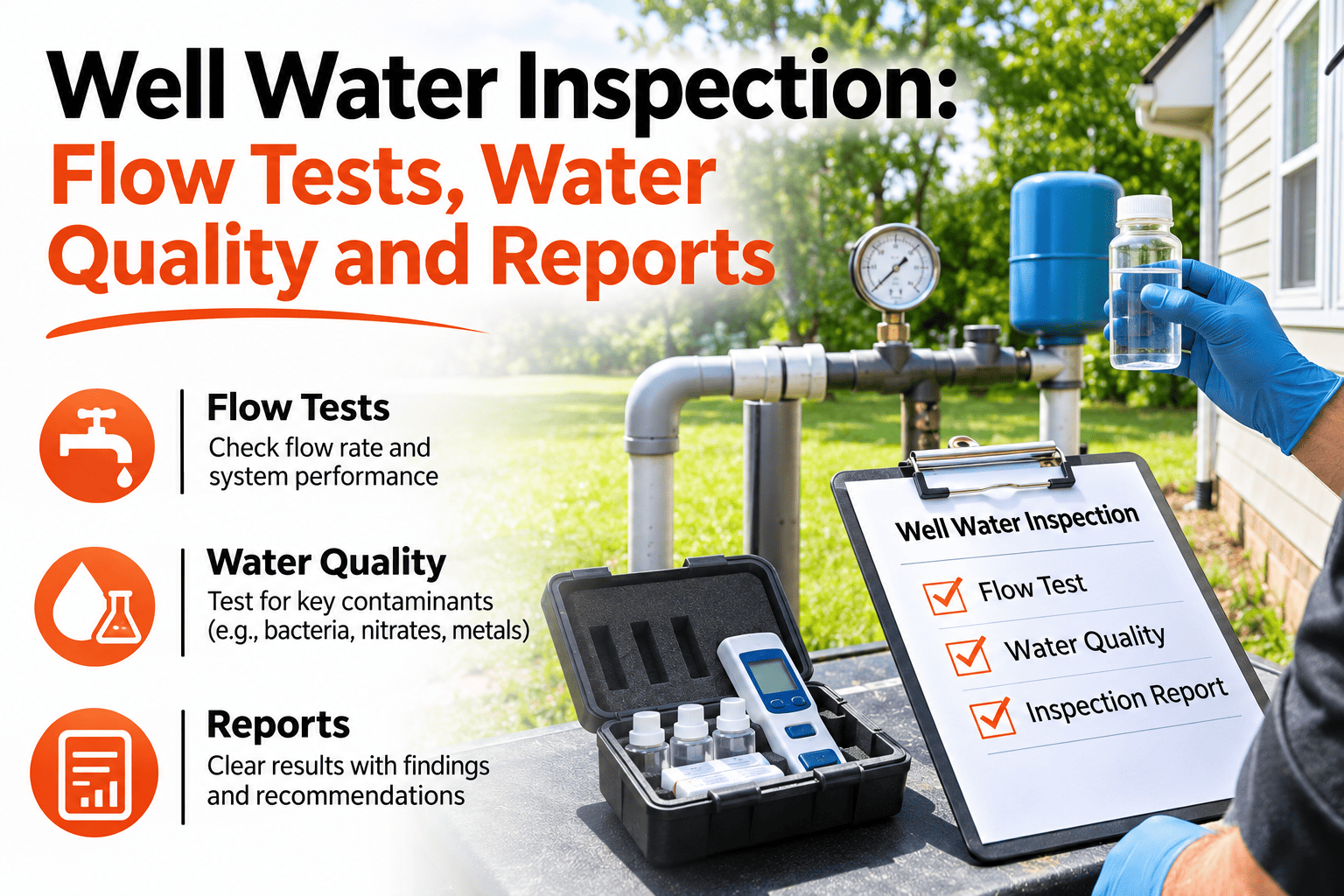
A home on a private well puts the water supply in the buyer's hands — no utility is testing it or standing behind the pump. A well inspection answers the two questions that matter: is there enough water, and is it safe to drink? This guide covers flow and yield testing, the water-quality tests for bacteria and nitrates, the pump and pressure tank checks, and what belongs in the report. Run well inspections in HomeInspecto.
Specialty inspection guide
Well water inspection: flow tests, water quality, and reports
Most of the system is underground. A good inspection reads it from the cap down to the water level.
- Well capSanitary seal above grade
- Ground level
- Casing & groutKeeps surface water out
- PumpDraws water up to the home
- Water levelThe aquifer the well draws from
The two questions a well must answer
Every well inspection comes down to quantity and quality — enough water, and water that's safe. The tests split along that line.
Enough water?
Flow and yield testing measure how much the well delivers and whether it keeps up with a household.
Safe water?
Laboratory testing checks for bacteria, nitrates, and other contaminants a private well can carry.
Flow test vs yield test
Both measure water in gallons per minute, but they answer different questions about the supply.
-
Flow test
"How much is the system delivering right now?"
- Measures the delivered rate in gallons per minute
- Often run from the spigot at the pressure tank, without opening the casing
- A functional check of what reaches the taps
-
Yield / drawdown test
"Can the well sustain that over time?"
- Runs water continuously until drawdown stabilizes
- Shows the rate the aquifer can keep recharging
- A more extensive test of the well's real capacity
A well can deliver a strong flow for a few minutes and still run short under a full day's demand, which is what the yield test catches. See both tests in a demo.
Water quality testing
Private wells aren't treated or monitored, so the water has to be tested. The best sample point is a tap near the pressure tank.
- Coliform & E. coliThe core safety test — bacteria that signal contamination from the surface or a failing seal.
- Nitrate & nitriteOften from fertilizer or septic influence; high nitrate is a particular hazard for infants.
- Metals & moreDepending on the region: arsenic, lead, iron, manganese, hardness, and pH.
For a home bought with an FHA or VA loan, the water is generally required to be tested for total coliform and E. coli, lead, nitrate, and nitrite. After closing, testing for bacteria and nitrate every year or two keeps the supply honest. Log sample points and results in HomeInspecto.
Read the well, top to water level
Document the cap, casing, pump, and pressure tank, record the flow and the lab results, and hand over a report a buyer can trust.
The mechanical system
Much of the hardware is visible at the wellhead and in the basement. These are the parts to check while the system runs.
Well cap & sanitary seal
Intact, above grade, and sealed — a damaged or low cap lets surface water in.
Casing & grout
Sound casing and grout keep contamination from running down the outside of the well.
Pump
Checked for operation and unusual noise; much of it sits out of sight.
Pressure tank
Watch the cycle — rapid, short cycling points to a waterlogged tank or a failing pump.
Pressure switch & gauge
The cut-in and cut-out pressures, often around 30 and 50 psi, read while it runs.
Wiring & controls
Accessible electrical at the pump and tank, checked for condition.
A flow-test well inspection commonly runs about $300 to $600, with the lab panel billed on top. See the component checklist in a demo.
Red flags
A handful of findings should stop a buyer and prompt a closer look by a well contractor.
- !A positive coliform or E. coli result — the water isn't safe to drink without treatment.
- !High nitrate, especially where infants will live in the home.
- !A well cap that's damaged or sitting below grade — a direct path for contamination.
- !A pump that cycles rapidly, or low and fluctuating pressure.
- !Air sputtering from the taps, which can mean a dropping water level or an air leak.
- !No history of water testing at all — an unknown that's worth resolving before closing.
Odor, sputtering, and short cycling rarely fix themselves — they point to the well or the pump. Flag each red flag in HomeInspecto.
How HomeInspecto handles well inspections
Cap-to-aquifer template
Wellhead, casing, pump, and pressure tank in order so nothing is missed.
Flow & yield fields
Record the delivered rate and the drawdown result with the finding.
Lab result log
Capture coliform, nitrate, and metals results against the sample point.
Pressure-cycle notes
Record cut-in and cut-out and flag short cycling.
Photo on every finding
The cap, the tank, and any defect documented with an image.
Record per property
Tests and inspections stay on file for the next owner and the next test cycle.
The whole private water system, documented end to end. Book a demo on your own workflow.
Frequently asked questions
What does a well inspection include?
A check of the wellhead, cap, casing, pump, and pressure tank, a flow test of the delivered water, and laboratory testing for bacteria and nitrates. See the flow in a quick demo.
What's the difference between a flow test and a yield test?
A flow test measures the rate the system delivers right now, often from the pressure-tank spigot. A yield or drawdown test runs water until it stabilizes to show what the aquifer can sustain over time.
What should well water be tested for?
At minimum, coliform bacteria and E. coli plus nitrate and nitrite. Depending on the region, add arsenic, lead, hardness, and pH. FHA and VA loans generally require the bacteria, lead, and nitrate panel — start a free trial to log results.
How much does a well inspection cost?
A flow-test inspection commonly runs about $300 to $600, with the laboratory water panel billed separately. Costs vary by location and the number of tests.
What are signs of a well problem?
Low or fluctuating pressure, air sputtering from taps, a pump that cycles rapidly, and unusual noises from the pump or tank. Many well components are underground, so these symptoms are often the first clue. See how they're logged in a demo.
Enough water, safe water
Document the well from the cap to the water level
A cap-to-aquifer template, flow and yield fields, a lab-result log, and pressure-cycle notes — the whole private water system, built in.