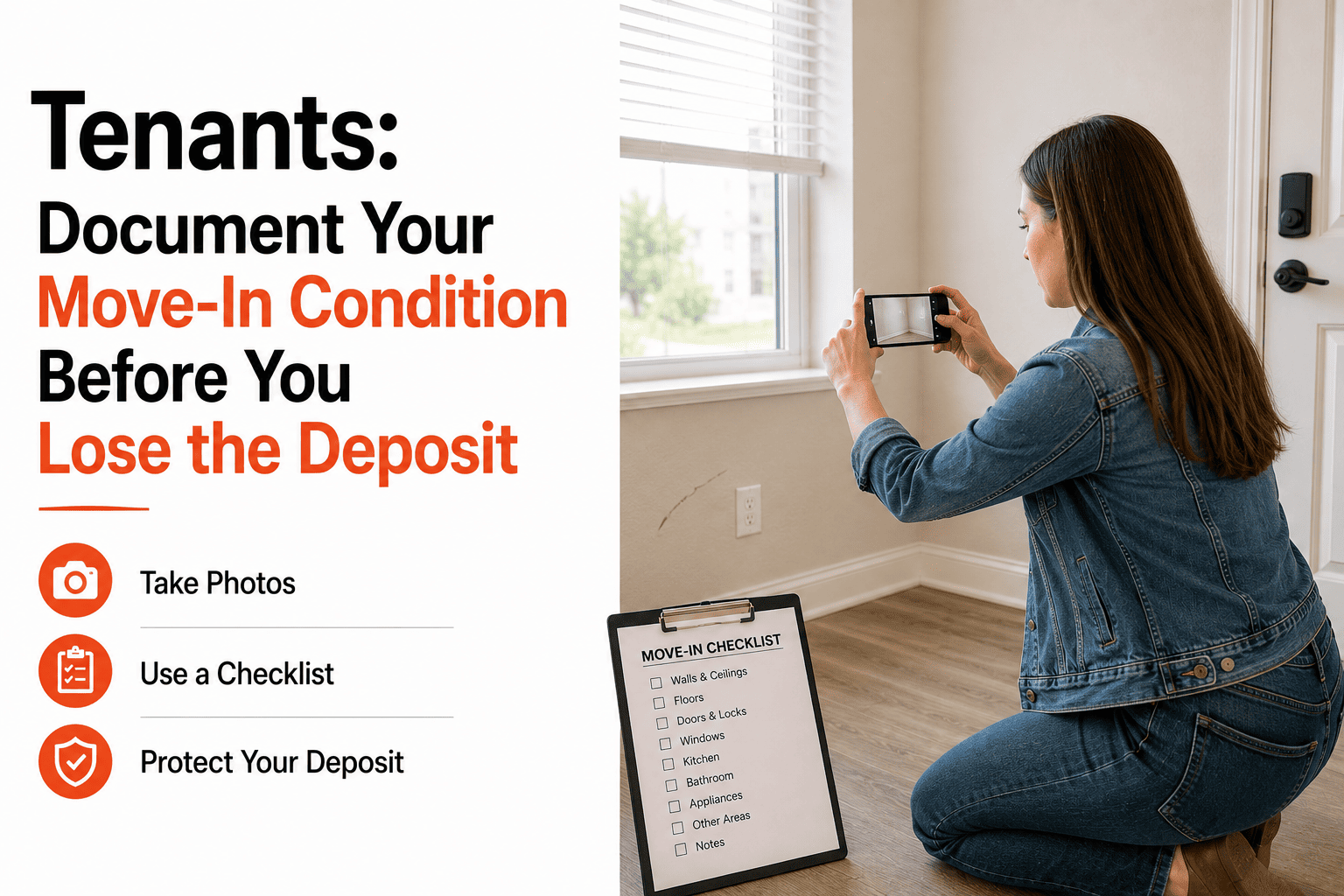
Your security deposit is at risk the moment you walk through the front door without documentation. Landlords who deduct for pre-existing damage — a scuffed wall, a stained carpet, a scratched countertop — can do so because you have no timestamped proof that the damage was there when you moved in. The landlord's form is their document, written to protect their interests. Your own move-in inspection — room by room, photo by photo, on your phone — creates the evidence that protects yours. This guide shows tenants exactly how to document move-in condition, what to photograph, how to produce a report that holds up in a deposit dispute, and why doing it yourself with a guided checklist is faster and more thorough than scribbling "OK" on the landlord's paper form. If you want to try a guided move-in inspection, book a demo.
Tenant Protection — Move-In Documentation
Document It Before You Unpack. Your Deposit Depends on It.
Do not rely on the landlord's form. Run your own timestamped move-in inspection with photos so your deposit is protected from day one.
Why the Landlord's Form Is Not Enough
Most landlords provide a move-in checklist — a one-page form with "good/fair/poor" ratings and a signature line. This form exists to protect the landlord, not you. It rarely includes photos, timestamps, or the level of detail needed to prove pre-existing damage in a dispute.
No photos
A checkbox saying the carpet is "fair" does not show the stain under the dining table. Your photo does. Without images, any condition claim is your word against the landlord's — and landlords hold the deposit.
No timestamps
A paper form carries whatever date is handwritten on it. A digital report auto-stamps every photo and entry with a date, time, and device — creating a verifiable record the landlord's form cannot match.
No detail
"Walls: Good" does not document the three nail holes behind the bedroom door. A room-by-room digital walkthrough captures every surface, every fixture, and every existing imperfection — the detail that matters at move-out.
No copy for you
Many landlords keep the original form and never provide a copy. A self-inspection on your phone produces a PDF you keep, share, and reference anytime — stored in the cloud, not in the landlord's filing cabinet.
How to Run Your Own Move-In Inspection
This takes 30 to 45 minutes and produces a report that is stronger than any paper form. Walk every room in order, photograph every surface, and let the checklist guide you.
1
Do it before you bring anything in
Run the inspection the day you get the keys — before furniture, boxes, or cleaning. Every surface should be empty and visible. Damage hidden by your couch cannot be documented later.
2
Photograph every room — overview first, then details
Start with a wide shot from the doorway of each room. Then photograph every existing mark, stain, scratch, crack, scuff, and imperfection up close. More photos is always better — you cannot go back and re-photograph after you have moved in.
3
Check every fixture and appliance
Run every faucet. Flush every toilet. Open every cabinet. Test every burner, outlet, and switch. Check window locks, door hardware, blinds, and the garbage disposal. If something does not work, photograph it and note it. This is the moment to document — not when you need it fixed.
4
Generate and save the report
Produce the PDF immediately. Email a copy to yourself and to the landlord. The report is now timestamped, in both parties' records, and cannot be altered. If a dispute arises months or years later, this document is your first exhibit.
Your deposit is worth protecting. The inspection takes 30 minutes. HomeInspecto gives tenants a guided room-by-room checklist, auto-timestamped photos, and an instant PDF report — everything you need to prove condition at move-in.
What to Document in Every Room
Consistency matters. Check and photograph the same items in every room so your move-out inspection follows the same path and produces a clean comparison.
Every room
Walls (scuffs, holes, paint), ceiling (stains, cracks), flooring (scratches, stains, damage), baseboards, doors (operation, hardware), windows (seals, locks, screens), blinds, outlets, switches, light fixtures.
Kitchen
Countertops, cabinet interiors, sink and faucet, disposal, dishwasher, oven/range, range hood, refrigerator (shelves, drawers, seals), backsplash, flooring under appliances.
Bathrooms
Toilet (operation, base seal), tub/shower (caulk, grout, drain), vanity and sink, mirror, exhaust fan, towel bars, tile condition, under-vanity for moisture.
Exterior / assigned areas
Front door (hardware, weather stripping), patio or balcony, parking space, storage unit, mailbox, garage. Photograph any existing damage to common-area surfaces adjacent to your unit.
Your Photos Are Your Proof. Take Them Before You Move In.
HomeInspecto gives tenants a guided checklist, timestamped photos, and an instant PDF — so your deposit is documented from day one, not disputed on day last.
Frequently Asked Questions
Can a tenant run their own move-in inspection?
Yes. In most states, tenants have the right to document property condition at move-in. Some states legally require landlords to offer an inspection with the tenant present. Even where not required, your own photo-backed inspection creates evidence that protects your deposit — regardless of whether the landlord provides a form or not.
Will my self-inspection hold up in a deposit dispute?
Yes, if it is timestamped, photo-backed, and produced on or before your move-in date. Courts want evidence of the unit's condition at the start of the tenancy. A digital report with timestamped photos is stronger than a paper form with checkboxes — especially if you emailed a copy to the landlord on move-in day.
How long does a tenant move-in inspection take?
Thirty to forty-five minutes for a standard apartment or rental home. Photograph every room, test every fixture, and note every existing mark. It is worth the time — your deposit is typically one to two months' rent, and the documentation protects every dollar of it.
Does HomeInspecto work for tenants?
Yes. HomeInspecto provides guided checklists, timestamped in-app photo capture, and instant PDF generation — designed for anyone documenting property condition, including tenants. Run your move-in inspection on your phone, generate the report, and email it to your landlord the same day. Book a demo or start a free trial.
Protect Your Deposit Before You Unpack.
HomeInspecto gives tenants timestamped, photo-backed move-in documentation in 30 minutes — so your security deposit is protected from the very first day. Book a demo or try it free.